VERSIONS: روسيا اليوم NOTICIAS FREEVIDEO ИНОТВ RTД
breakingnews
Go to main page   News   NATO risks spilling own blood while mounting pressure on Gaddafi  
MORE ON THE STORY
Syria, Daraa: Syrian women (unseen) shower army troops with rose petals and rice (AFP Photo / Louai Beshara) 29.05.2011, 15:57 6 comments

UN learning from its mistakes – RT contributor

Despite the growing international preoccupation with the events in Syria, the UN does not seem to rush with a resolution on Syria as it did with Libya.

Arab world protests
Libya, Benghazi: A Libyan woman flashes the V for "victory" sign during a demonstration against Moamer Kadhafi in the revolution square of the rebel stronghold eastern city of Benghazi on May 27, 2011. (AFP Photo/ Saeed Khan) 29.05.2011, 08:46 9 comments

Gaddafi only obstacle to peace – Libyan transitional council head

While the world leaders attempt to map out a settlement of the Libyan conflict, The Chairman of the National Transitional Council Mustafa Abdul Jalil spoke to RT about his vision of peace in Libya.

Arab world protests Libyan conflict
G8 leaders agreed that Russia was the "most qualified" to head mediation talks with Libya  AFP Photo / Saeed Khan 29.05.2011, 05:04 7 comments

‘Victory or death for Gaddafi’ – political analyst

While the G8 leaders agreed that Russia was the "most qualified" to head mediation talks with Libya, professor Mark Almond warned that NATO appears to be intent on carrying on its military campaign until the bitter end.

Libyan conflict
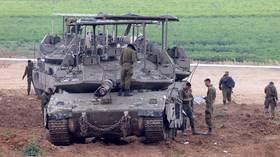
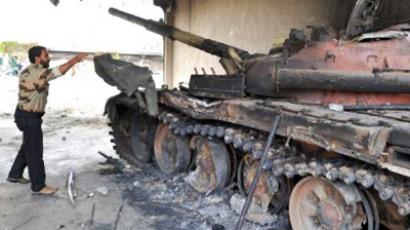
A tank for Moamer Kadhafi's forces that was destroyed by a NATO bombing, AFP Photo / Christophe Simon 10.05.2011, 12:11 3 comments

Military means in Libya no quick fix – British activist

NATO is now deeply entrenched in Libya in what looks like a civil war and there is no visible end to the illegal intervention, insists British anti-nuclear activist Kate Hudson from the Campaign for Nuclear Disarmament.

Arab world protests Libyan conflict
The UK Ministry of Defense 23.04.2011, 00:33 4 comments

UK committed for long haul in Libya

The UK Ministry of Defense sending military advisors to Libya is seen by many as the most significant step so far towards deploying ground troops. Once that happens, many see Libya turning into another Afghanistan – ten years and counting.

Libyan conflict

NATO risks spilling own blood while mounting pressure on Gaddafi
Published: 30 May, 2011, 16:37
Edited: 30 May, 2011, 22:25

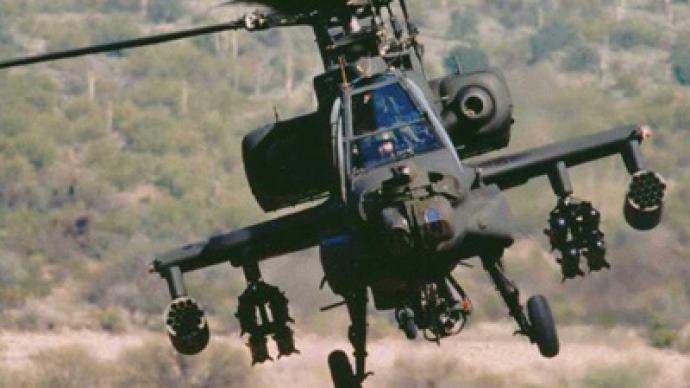
An Apache helicopter (image from blogspot.com)

(11.9Mb) embed video
TRENDS: Libyan conflict

TAGS: Arms, Conflict, NATO, UK, Politics, Alice Hibbert, Libya, Laura Smith


NATO is stepping up its pressure on Colonel Gaddafi as Britain and France are ready to deploy strike helicopters into Libya. But it comes at the risk of suffering their first casualties after two months of one-way bunker buster bombing.

NATO Secretary General Fogh Rasmussen said on Monday Gaddafi’s “reign of terror is coming to an end”. He added the coalition forces will keep pressuring the Libyan government as it’s coming closer to achieving its goals.

Part of this mounting pressure is the deployment of the strike helicopters, which are soon to provide  NATO forces in Libya with new capabilities.

“They can fly low; they can fly slow; so they can hit targets that fast jets can’t hit from the air. They also involve a fair amount of risk. They can be shot down much more easily than a fast jet, so the prospect of NATO personnel being captured on the ground has just gone up,”
explains Shashank Joshi, associate fellow a the defense think tank Royal United Services Institute.

The Apaches, which will be joined by a contingent of French helicopters, can maneuver in urban areas and attack fairly small targets. They’ll make it easier to take out arms stores, and target places where Colonel Gaddafi may be hiding.

The deployment is part of Prime Minister David Cameron’s strategy to “turn up the heat” in Libya.

“They seem to think if they quote the UN resolution at the same time as they call for Gaddafi to go and for regime change, it’s a sort of guarantee, or as a laissez-passer. Frankly they’re involved in a civil war in Libya. The deployment of helicopters, the intensive bombing of Tripoli that’s going on – this is a war about regime change,” British MP Jeremy Corbyn believes.

The helicopters mark only the latest escalation of this conflict. Following the no-fly zone, NATO sent in advisors to train the rebels, introduced drone patrols and by the first week of May, had flown nearly 6,000 strike sorties, with Tripoli subjected to the heaviest bombing.

A recent YouGov poll for the Sun tabloid newspaper showed less than half of Britons now support the intervention in Libya. But that number’s likely to plummet once UK troops are in significantly more danger.

“Just wait, if a helicopter crashes and God forbid we lose ten people… If that happened, [if] we started being blown out of the sky – don’t even think about it. So the issue is we haven’t dropped any blood. Yeah, we’ve dropped tens of millions of pounds which we haven’t got, but not single one of our people has died. When that happens, the game, and the PR game, will change,” Kelvin MacKenzie, former editor for The Sun expects.

People have marched against the Libyan war in the UK, but in small numbers compared to the million that marched ahead of the invasion of Iraq. But helicopters bring the fighting closer to the ground, and with it, a higher risk of death, as well as fierce opposition at home.

The government might be able to defend that, as long as the new strategy makes rapid progress. But if it doesn’t, many see the next step as troops on the ground – in clear defiance of the UN resolution that allowed the original no-fly zone to be enforced in Libya.

­The situation is getting worse for the West in Libya, as an operation which they believed would be short and easy is taking longer than expected, said Patrick Hayes, a reporter for the London-based Spiked online magazine.

“In many ways it seems that the situation is getting worse for the West in Libya,” Hayes said. “I think that at first they thought they could swoop in and actually bomb the country into democracy. They thought this is going to be quite a quick process, where they could basically keep their hands [clean] at a distance – bomb [their way] into Libya, get rid of Gaddafi and then everything will be all right. Now obviously that is not the case. And these bunker-buster bombs and helicopters are inevitably going to make the situation worse. They could bring about civilian casualties in Libya, and I think that reeks of desperation.”



embed video

+5 (5 votes)
 
Back to top
next MORE NEWS
BELGRADE : A protestor holds a flag with a picture of Ratko Mladic. (AFP Photo / Andrej Isakovic) 30.05.2011, 13:39 9 comments

Mladic won’t live to see Hague trial - lawyer

Lawyers of the former Bosnian Serb general Ratko Mladic have lodged an appeal against his extradition to the Hague as they are afraid he might fail to live to the trial. Meanwhile thousands protest Mladic arrest in Belgrade.

Syrian Kurds hold a huge Syrian flag during a pro-democracy demonstration calling for political changes in Syria in the predominantly Kurdish northern Syrian city of Qamishli on May 27, 2011 (AFP PHOTO) 30.05.2011, 19:36

Syria: the times of peace will come

Many Palestinian refugees have found a new home in Syria and they do not support the ongoing riots. RT’s Nadezhda Kevorkova talked to one of the refugees, horse breeder Abu Saleh, who believes that the time of peace will come.

Arab world protests
PR101 May 31, 2011, 17:19
0

Spelling correct: This is meant to be invincible not invisible.

Commander May 31, 2011, 14:49
0

NATO will do everything that it possibly can in order to achieve its objectives in Libya.  Soon there will be a "humanitarian" invasion of the North African country.  If there is a loss of NATO lives, the big powers will simply see this as a simple business exchange:  blood for oil.  Always remember, that world issues are always dictated and controlled by the big transnational corporations, which includes the big oil companies. 

PR101 May 31, 2011, 14:07
0

Konstantin Lighting war has number of closely related meanings that include: the use of massive- overwhelming blow against the enemy that is intended to produce maximum damage to the enemy and minimum to the soldiers of the nation(1) that that delivered that overwhelming blow- which in turn means, there is no regards to the lives-both civilians and soldiers- of those who receive this overwhelming blow. This is the basis of 20th century armoured total war. So you see I do understand what this term means. In lighting wars, the lives of the enemy do not matter. How do you think this military tactic failed in the Eastern Front? Because those trained in the Blitzkrieg formula had philosophical mindset that sadly convinced them that lighting warfare armoured them from death! This is where the Germany got the term “invisibility” but the Russians got them out of their armoured vehicles and force them to fight and that is why Germany lost the war in the Eastern Front because the lighting war from a distance has failed in the East.