Doomed to fail: Mideast Quartet’s efforts resume
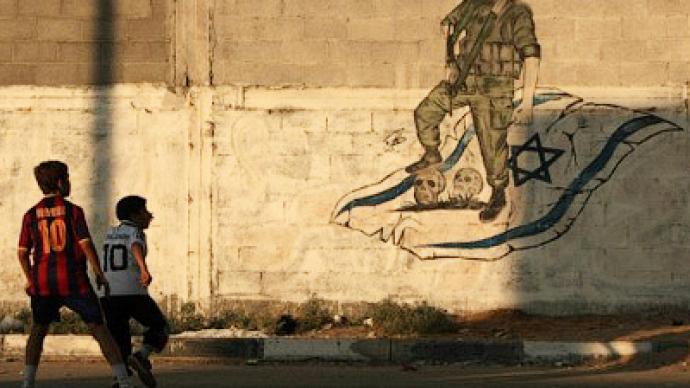
The diplomatic Quartet conducted separate meetings with Israelis and Palestinians on Wednesday, but hopes remained low that Russia, the US, EU and UN could jumpstart the stalled peace process.
The conflicting sides, as well as major powers in the region such as Jordan, are pessimistic. Even the mediators themselves are not optimistic. It is no surprise: after a 20-year-long peace process in the Middle East, with negotiations revolving around essentially the same things, it is very unlikely a failure would suddenly become a success. Recent changes in the region may bring in new rules, however.Let us remember a few statements made in the run-up to the Israel sessions. The Quartet’s chief negotiator, Tony Blair, said that Arab revolutions would serve to complicate the Israeli-Palestinian settlement process. "It is a great thing that people are wanting democracy, but in the short-term there is reduced stability in the region so that can pose problems for Israel and the peace process," said Blair.Palestine’s Saeb Erekat responded by saying that Israel is the only obstacle to peace efforts in the region."It is the Israeli occupation which is impeding peace and democracy,"Erekat was quoted by the Ma'an news agency as saying, adding that the Palestinian side remains committed to all international guidelines and terms of the Quartet's roadmap for peace.The exchange was continued by Jordan’s King Abdullah II who told CNN that even though he was ever the optimist in the region, he is, for the first time, feeling pessimistic with regard to the Israeli-Palestinian conflict.“I am one of the most optimistic people you’ll meet in the Middle East and for the first time I’m very pessimistic about the Israelis and Palestinians moving forward," he said.“Israel is not really interested in a two-state solution, and what is the other option?" the Jordanian king added.Abdullah's comments came just as Foreign Minister Avigdor Lieberman severely criticized Palestinian President Mahmoud Abbas, calling him the "greatest obstacle" to Middle East peace. "If there is one obstacle that should be removed immediately, it is [Abbas]," he said.
Smiley masks off
It is no secret that the Israeli-Palestinian peace process has long since come to a standstill. What is amazing is that the mediators had naively hoped to give negotiations a boost. At any rate, they gave the impression of being hopeful. They are not trying to hide their feelings anymore – in fact, they now seem to be apologizing in advance for their inevitable failure. Set against the background of pointless diplomatic games, two statements made recently in Moscow looked like a revelation. One came from former Russian diplomat Alexander Krylov, who had spent many years working in Israel and is now employed as a scientist. The other was made by Giora Eiland, a retired Israeli Major General and a former National Security Advisor. Two strikingly honest statements were made by two retired heavyweights in stark contrast to what we are hearing from official channels.Speaking at a conference marking the 20th anniversary of Russian-Israeli relations in Moscow, Krylov said it would be impossible to untie the Middle Eastern knot as long as the international legal framework for negotiations remains as it is now. UN Security Council resolutions 242 and 338, the basis for the Quartet’s roadmap and a mantra for Quartet diplomats, are obsolete since they are no longer tied to the current state of affairs.“At the same time, if negotiations last for another 10-15 years, there will be nothing left to talk about. Israel will simply swallow up the West Bank,” Krylov said.In his opinion, as long as the outcome of the Arab Spring revolutions is not clear, there is no way Israel is going to allow any new formations with the potential to cause the instability zone to arrive at its borders.In his turn, Giora Eiland told Russian journalists during his visit to Moscow that he does not rule out the possibility that if negotiations fall through, we can expect a new intifada, or even an outbreak of the Arab Spring on Palestinian territories. Just like the Russian ex-diplomat, he does not believe in the success of the negotiations under current conditions.Moreover, Eiland maintains that both Palestinian and Israeli leaders are more interested in keeping up the negotiation process rather than reaching an agreement, since the latter can only be achieved through a compromise which will inevitably raise the ire of a significant proportion of their populations. Besides, ploughing on with the negotiations while Fatah and Hamas remain in conflict, and thus having to bet only on one of these two forces is a sure way to get nowhere with the implementation of any agreement reached. Nonetheless, both Palestinians and Israelis are trying hard to prove their commitment to the settlement process – whether to their own people (which is more true in case of Abbas) or to the international community (which is true for both Abbas and Netanyahu). And this is the reason why each side is so eager to lay the blame for the failure of negotiations at the other’s door.Incidentally, as a true Israeli, Eiland does not deny himself the pleasure of adding that unlike the Palestinians, Netanyahu has not set any pre-conditions for negotiations and that it is the Palestinian side that refuses to acknowledge Israel as a Jewish state.At the same time, Eiland points out that any further attempts to settle the conflict based on the concept of two states for two peoples are most likely to drive the negotiation process to a deadlock. He believes that there must be a new way. But which way that is, only time will tell.
Political uncertainty cripples talks too
The Middle East has been going through so much change that Israel now finds itself facing a situation with too many unknowns.Who will come to power in Egypt? What if they choose to denounce the Camp David accords? What will happen to Syria?Some of the further questions for Israel to ponder are related to the US troop withdrawal from Iraq and the strengthening of Iran’s and Turkey’s positions in the region, with Turkey unlikely to return to partnership relations with Israel in the near future. As far as Iran is concerned, Eiland maintains that within just a few years, Israel will have to choose between accepting the reality of a nuclear-armed Iran, and taking action to prevent this. Each of the two options is fraught with serious challenges. But the most difficult realization is the fact that doing nothing on the issue effectively means opting for acceptance. Israel was recently faced with a similar dilemma (only on a smaller scale), when it had to decide on a prisoner swap which eventually brought home Sergeant Gilad Shalit in exchange for the release of 1,027 Palestinians from Israeli prisons. According to Giora Eiland, Israel had to choose between two options, both of them bad: letting down Shalit or agreeing to set terrorists free.Eiland believes that, despite the moral high ground and the support of 80 per cent of Israelis, the swap was a mistake in strategic terms, as it may encourage terrorists to abduct more Israelis. “But what can you do about it – we are crazy,” Eiland adds.Yet however crazy the Shalit deal might seem, it does not come anywhere close to the disaster that Israel may expose itself to by making concessions in negotiating with the Palestinians – especially given the overall volatile situation across the Middle East. This primarily concerns territorial concessions and other measures that would affect the ethnic balance in Israel.The face-saving tactic of drawing out the negotiations in order to buy time is a risky one, but at least it is well-tested and efficient. Moreover, the Palestinian leadership is content with this kind of standstill.
Marianna Belenkaya, RT Arabic
The views and opinions expressed in the story are solely those of the author and do not necessarily represent those of RT.