VERSIONS: روسيا اليوم NOTICIAS FREEVIDEO ИНОТВ RTД
breakingnews
Go to main page   News   Merkel gives EU the FU  
MORE ON THE STORY
German Chancellor Angela Merkel (L) talks with British Prime Minister David Cameron (AFP Photo / ERIC FEFERBERG) 16.11.2011, 16:24 10 comments

Berlin rebukes ‘greedy Brits’ in battle for Europe’s future

With Berlin jockeying to take the reins of the EU, a top German official says Europe is ‘speaking German’. But as Angela Merkel eyes a political union to rope in euro stragglers, the UK is challenging this drive in "the toughest hour since WWII."

Eurozone crisis
A trader sits in front of screens showing the German DAX index in Frankfurt am Main on November 1, 2011 at the German Stock Exchange (AFP Photo / Frank Rumpenhorst / Germany Out) 15.11.2011, 15:41 6 comments

Last rites for euro? Europe in 'worst crisis since WWII'

The eurozone could be falling apart at the seams. At what German Chancellor Angela Merkel called its “toughest hour since World War Two,” the UK and Germany offer competing visions of the European Union’s future as the debt crisis continues to deepen.

Eurozone crisis
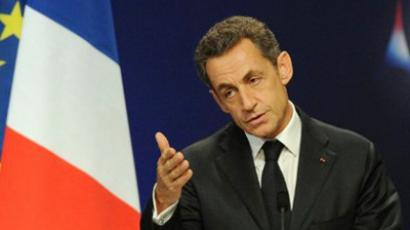
Nicolas Sarkozy at press conference in Cannes on November 3, 2011 (AFP Photo / Pascal Guyot) 04.11.2011, 00:57 5 comments

Euro must be preserved at all costs – Sarkozy

The sovereign debt crisis in the eurozone has dominated the first day of the G20 summit in Cannes. The Greek PM’s vacillating over a referendum in the country has brought added urgency to events as G20 leaders thrashed things out on Thursday.

Eurozone crisis
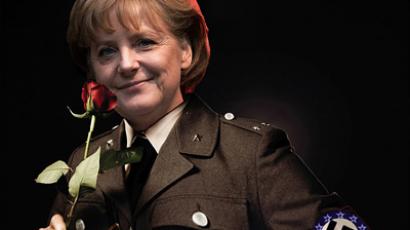
Poster of German Chancellor Angela Merkel in SS guard uniform (picture from greki-gr.blogspot.com) 28.10.2011, 20:05 16 comments

Greeks react to bailout by dressing up Merkel as Nazi

Harsh austerity measures imposed on the Greek people are making them look to the past for unfavorable comparisons. Overnight, posters featuring Chancellor Angela Merkel dressed as a Nazi officer have appeared all over the capital, Athens.

Eurozone crisis

Merkel gives EU the FU

Published: 02 December, 2011, 16:57
Edited: 02 December, 2011, 22:17

Angela Merkel (AFP Photo / John Macdougall)

(29.5Mb) embed video

TAGS: EU, Crisis, Merkel, Egor Piskunov, Rory Suchet


German Chancellor Angela Merkel has urged for “a Fiscal Union with strict rules” to address the root causes of the “Europe's widening financial crisis.” Though she said the process will take years.

Germany and France, which are the key players of the eurozone, are pushing forward the idea of creating a Fiscal Union which would include all 17 eurozone states or even all members of the EU. It would bring more centralization of power, more control over state budgets, and more importantly over their debts.

"The European crisis will not be solved in one fell swoop,'' said Merkel to the lower house of the German parliament on Friday. “There are no quick and easy solutions.”

She compared the process of solving the debt crisis to the marathon runners saying that “the one who starts fastest isn't necessarily the most successful. It is the one who is aware of what is involved in running the full distance."

De facto, the introduction of such a Fiscal Union would also mean the revisal of the European Union.

The UK, another key player of the EU – although not in the eurozone – also wants to take part in the reformation process. On Friday, French President Nicolas Sarkozy is meeting with British Prime Minister David Cameron, who is expected to voice support for the policy, as long as UK does not lose its influence in the process.

Merkel’s address comes ahead of the EU summit in Brussels on December 9 where she and French President Nicolas Sarkozy plan to propose joint action.

"We are going to Brussels with the intention to change the EU treaty," Ms. Merkel said. "The goal is a fiscal union that enforces both fiscal discipline in its members and has the necessary instruments to effectively handle a crisis."

The chancellor said that the goal of next week's summit is to change European treaties “to avoid a splitting of the eurozone and non-eurozone members."

Angela Merkel stressed that Germany will not support the idea of the Eurobonds, where all 17 members of the eurozone would share the responsibility for their debts. France and Germany are calling for the introduction of tougher sanctions against those countries which cannot pay their bills.

However, Merkel called for parliamentarians to realize what sacrifices people are making in countries not in the eurozone, like the Baltic states, Bulgaria and Romania, and "who don't get so much attention.” She said it is important to keep in mind the problems being faced by people in Spain, Portugal and especially in Greece.

Earlier on Thursday evening Sarkozy also delivered as landmark speech to 5,000 cheering supporters, saying that France and Germany wanted “more solidarity and more discipline” in Europe. 

But Arjo Klamer, professor of the Economics of Art and Culture at Erasmus University, believes that the economic disparity between the members of the EU will not be solved by the “fiscal union”.

I think that what is needed is all Europeans are going to pay taxes to Brussels so there will be just like in most countries, like the US, what is called the automatic stabilizers. If you do bad you pay fewer taxes, receive more benefits. Nothing of that is in place here in Europe. Merkel’s planes are not addressing that serious shortcoming.


embed video

­EU stuck in euro straightjacket

­The UK, another key player of the EU – although not in the eurozone – also wants to take part in the reformation process. On Friday, French President Nicolas Sarkozy is meeting with British Prime Minister David Cameron, who is expected to voice his support for the policy, as long as the UK does not lose its influence in the process.

Although not part of the eurozone, the UK has already contributed some €7 billion to Ireland and €9 billion to Greece via the IMF mechanisms. And British taxpayers might have to contribute another €6 billion if Spain needs a bailout.

“It is very unfair,” says Robert Oulds, the director of the Bruges Group. “In the situation when Britain is in a great deal of debt, the British government is having to bobble money from the financial markets to lend to other countries. This is something Britain can’t actually afford to do.”

The problems are with the euro and it should be broken up into more manageable parts, believes Oulds who is against a more integrated Europe.

“At the moment, the European economy is just stagnating because they stuck in the straitjacket of the European single currency,” he said.


embed video

0 (11 votes)
 
Back to top
next MORE NEWS
Intel idol: UK spy agency seeks talent 02.12.2011, 14:20 2 comments

Intel idol: UK spy agency seeks talent

British Intelligence is looking for future spies through a code-breaking game on the internet. But it seems geek talents cost more than the government can afford.

Richard Stallman 02.12.2011, 17:34 30 comments

Stallman: Facebook IS Mass Surveillance

The father of free software philosophy spoke to RT on evil developers, spying social networks, the almost-legitimacy of Anonymous hacks and the condition under which he would take a proprietary program and a million dollars.

jim evans December 03, 2011, 15:01
+3

Nay Lin....the British people don`t WANT to be run from Germany or China or the BRICS Union......any more than we wanted to be run by the Zionists for over sixty years.

In that time our industry has all gone and so has our empire and the City of London and the EU are just a great asset stripping machine taking what`s left of the flesh from our bones.

How do you know what we think? Our government and media are run by the same global capitalists who created modern China and Russia!

agalthatthinks December 03, 2011, 03:28
+8

Great, now they want to give the undemocratic European commission more power than ever before. That will mean more undemocratic and draconian decisions against their 500+ million citizens. Most countries inside the EU aren't really independent any more anyway, but now they are up to destroy what little is left. An it is not a lot.

Nay Lin Maung December 03, 2011, 03:28
0

I think that euro zone leaders have to reach out other people who live in the developed countries as well as developing countries.


There is hope.


Market likes it when all of the developed countries of their central bank agrees.


It  means that all developed countries of the central bank including BRICS countries and G 20 countries of their central banks have to agree on something how to improve euro zone crisis. [I think that it might help short-term needs for the euro zone.]


The leadership of the Germany said about establishing Fiscal Union might take years.


During the shorter time of the establishing Fiscal Union [FU], how the people of the euro zone is going to meet their obligation of their investors in the euro.


"Once for all Euro" It is good quote from Russia president adviser.