VERSIONS: روسيا اليوم NOTICIAS FREEVIDEO ИНОТВ RTД
breakingnews
Go to main page   News   UK: champion arms trader or champion of democracy?  
MORE ON THE STORY
David Cameron (L), Mustafa Abdel Jalil (C) and Nicolas Sarkozy (AFP Photo / Stefan Rousseau / Pool) 16.09.2011, 10:51 10 comments

Cameron, Sarkozy milk premature Tripoli triumph

The French president and British PM have visited Tripoli to declare victory over Muammar Gaddafi’s regime and reap the benefits of his fall, but it appears the celebrations are somewhat premature.

Libyan conflict
Nicolas Sarkozy (L) and David Cameron (AFP Photo / Patrick Kovarik) 15.09.2011, 13:22 10 comments

Cameron, Sarkozy pledge more power to new Libya

French president Nicolas Sarkozy and British premiere David Cameron have pledged to continue financial and military support for the National Transitional Council. The announcement came during the leaders’ joint visit to Libya.

Arab world protests Libyan conflict
UN peacekeepers patrol in a street of Abidjan, Ivory Coast (AFP Photo / Issouf Sanogo) 15.09.2011, 11:48 11 comments

UN to take charge of law and order in Libya

A failure to properly implement UN resolution 1973 aimed at protecting civilians in Libya crystallized into a full-scale civil war and foreign invasion, argues Russia’s UN ambassador, Vitaly Churkin. He says only the UN can break the stalemate.

Arab world protests Libyan conflict
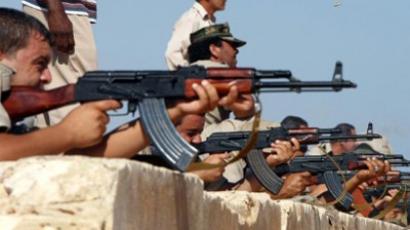
Libyan youths practice using rifles during training to join the fighting forces of the National Transitional Council (NTC) in the town of Tajura, Tripoli, on September 14, 2011. (AFP Photo / Mahmud Turkia) 15.09.2011, 10:02 9 comments

Silence and fear return to the streets of Tripoli

A month on from Tripoli’s fall to rebel forces, the leaders of France and Britain are traveling to the city in a show of support for the regime their warplanes helped put in power, while those who backed Colonel Gaddafi remain defiant but fearful.

Libyan conflict
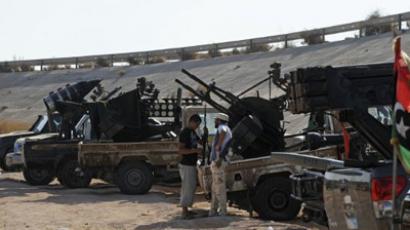
Libyan National Transition Council (NTC) fighters chat at the NTC's last outpost near Sadada, on the highway from Misrata to Sirte, one of the last strongholds of Libya's fugitive Moamer Kadhafi on September 14, 2011 (AFP Photo / FRANCISCO LEONG) 15.09.2011, 02:25 7 comments

Gaddafi’s Libya 'threatened Africa’s subordinate role'

With Libya’s transitional leadership saying they awaite state visits by British Prime Minister David Cameron and French President Nicolas Sarkozy, some analysts are warning that Africa may yet face echoes of its colonial past.

Libyan conflict

UK: champion arms trader or champion of democracy?

Published: 16 September, 2011, 14:02

BAE Systems CV9035 infantry fighting vehicle on the International Defence Exhibition and Conference (IDEX), (AFP Photo / Marwan Naamani)

(27.5Mb) embed video

TAGS: Arms, Conflict, Scandal, UK, Protest, Politics, Alice Hibbert, Ivor Bennet, Opposition, Libya, War


As British premier David Cameron ends a triumphant visit to Tripoli to celebrate the end of Muammar Gaddafi's dictatorial rule, British arms dealers are working flat out to keep other brutal regimes in power.

Selling weapons could be a moral minefield, but not at the DSEI (Defense and Security Equipment International), the world’s biggest arms fair and a massive earner for the British economy. The conscience being brandished in Libya has fallen strangely silent as Britain sets out for a day at the fair where international delegates shop for tanks, rocket launchers and missiles.

So long as business is being done, it does not seem to matter who is buying. This year’s guest list includes countries like Saudi Arabia and Bahrain, both regimes that violently suppressed pro-democracy demonstrations earlier this year.

Bahrain was accused of opening fire on its unarmed citizens in February. Saudi Arabia sent its National Guard in to help, driving armored vehicles made by BAE Systems, the UK’s largest defense company. However, like the British government, the company cannot change its spots. It says there are countries it will not sell to, but that does not include any of those present at the fair.

RT spoke to BAE Systems’ demonstrations manager, Per Kjelltoft, to ask him about his company’s policy towards repressive regimes.

RT: If a country has been invited here by the British government, it is probably going to be on your list of countries you are able to sell to, presumably?

Per Kjelltoft: Makes sense, yes.

RT:  Do you think it is right to sell to regimes like Bahrain that have repressed democracy protests?

PK: I do not have any comments on that one.

While representatives of controversial countries eye up the wares on offer, anti-war protesters are doing their best to get a different message across. Activists are angry the fair is going ahead despite the recent crackdowns in Libya and Egypt, both former customers of Britain, which have used British-made weapons against their own people.

“We are paying the price now in the Mediterranean because we have sold weapons to nearly all the countries that are now experiencing the Arab Spring,” said Bruce Kent, of the Campaign for Nuclear Disarmament.  “I think it is short-sighted, it is bad for this country. It does not make money, it makes wars.”

This year’s shoppers include 14 countries branded authoritarian by human rights groups, a fact the government came clean on just one day before trade began.

“I am sure they are very embarrassed because on the one hand, in February, David Cameron was going to Egypt walking around Tahrir Square, proclaiming his belief in human rights and freedom and democracy,” said Kaye Stearman from Campaign Against the Arms Trade. “And the next stop was Kuwait, and it turned out he was travelling with eight arms company executives and the whole purpose of the trip was trade and one of the main trades they were trying to promote was weapons trade to the Middle East.”

The government says it is tightening restrictions on who can buy weapons that could be used for repression. It claims an invite to the DSEI does not guarantee an export license. Still, defense is big business for Britain. It generated 22 billion pounds for the economy last year, making the UK the second-biggest weapons exporter in the world, and with money like that up for grabs, turning customers away empty-handed may indeed prove difficult.


+5 (7 votes)
 
Back to top
next MORE NEWS
image from http://south-stream.info 16.09.2011, 12:53 4 comments

Russia puts end to gas wars

Russia has brought to an end the long-running debate over securing gas supplies to the EU, bringing all its European partners together to sign the landmark agreement giving the green light to construction of the South Stream gas pipeline.

Upper Atmosphere Research Satellite, UARS (AFP Photo / HO / NASA) 16.09.2011, 14:16 3 comments

Six-ton NASA satellite to collide with Earth

A six-ton weather satellite which has been out of NASA’s control since 2005 is to plunge to Earth on September 23, latest estimates show. US and Russian experts disagree over where the debris will hit.

Nadeem Alam November 19, 2011, 12:10
+1

What would have been the harm if the Developed Countries had sold the Technology beneficial to Ordinary Human beings ? Still they could have made money as they do now selling Computers, Vehicles, Aeroplanes, etc. to the under developed countries.  Unfortunately they are bent on creating a WAR Hysteria arould the world to satisfy their lust for more and more money (which will not end.)

Bogdan (unregistered) September 26, 2011, 18:16
+1

There is no surprise at the way the world works. Nobody is supposed to be naive. The only slightly irritating thing, at least to a EU citizen living in the UK who has not yet been imbued with national rethoric, is travesting what everyone else does with the made-in-UK hypocrisy of being better than others and the champions of democracy. The recent MP visit to Russia was a telltale one, for example, as far as this is concerned. It is all about demand and supply, isn'it. So, please stop dressing up vested interests under the flag of democracy.

JuanitoN September 17, 2011, 03:47
+1

Stockholm's Peace Research Institute reports top arms exporters 2010 in order of $ value of exports: US, Russia, Germany, China, UK, France, Sweden, Italy, Spain, Netherlands. As for Bahrain, it is ranked #3 amongst Arab League States in its Human Development Index of .801 - a Very High Human Development level. No doubt that most of the top arms exporters are sending weapons to states lower on the HDI than Bahrain.