VERSIONS: روسيا اليوم NOTICIAS FREEVIDEO ИНОТВ RTД
breakingnews
Go to main page   News   Referendoomed: No go for Russian language in Latvia  
MORE ON THE STORY
Thousands of Russian schoolchildren protest ammendments in the Latvian education law which increase the number of subjects taught in the Latvian language by 60 per cent at minority secondary schools (AFP Photo / Ilmars Znotins) 06.02, 11:44 48 comments

Too Russian to have rights? Latvia to vote on 'alien' language

Latvia’s large Russian minority has given voice to its anger over escalating institutional discrimination. People are now hoping that an upcoming referendum on February 18 could see their language officially recognized.

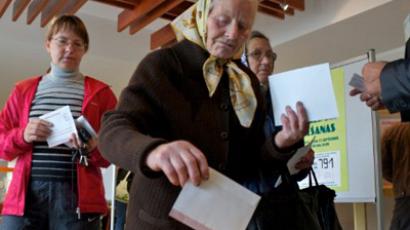
A woman casts in her ballot paper during the early parliament elections at a pooling station in Jaunmarupe (AFP Photo / Ilmars Znotins) 19.09.2011, 13:35 5 comments

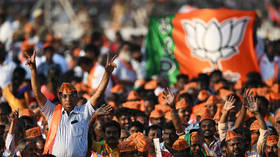
Latvia’s pro-Russian party rocks the vote

A party that works to protect Latvia's Russian-speaking minority has won early parliamentary elections, highlighting this Baltic nation's exasperation with politics as usual.

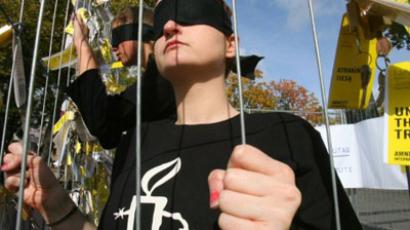
Amnesty International members and opposition protest in front of government headquarters in Vilnius to urge Lithuania to reopen a probe of claims that it hosted a secret US interrogation center for Al-Qaeda suspects, September, 29 (AFP Photo / Petras Malukas) 25.11.2011, 12:33 3 comments

Lithuania: A Gitmo on the Baltic?

The Baltic state of Lithuania is facing a lawsuit for hosting a secret CIA prison on its soil as a Guantanamo Bay prisoner who claims he was detained and tortured there takes his case to The Hague.

Referendoomed: No go for Russian language in Latvia

Published: 18 February, 2012, 10:00
Edited: 20 February, 2012, 17:31

Riga: Youths walks past a sign at the entrance of a polling station in Riga on February 16, 2012, ahead of the February 19 referendum (AFP Photo/Ilmars Znotins)

(26.4Mb) embed video

TAGS: Politics, Human rights, Baltic states, Aleksey Yaroshevsky, Opposition


A majority of Latvian voters have rejected a proposal that would have made Russian a second official language. The result was expected, as the country's top politicians had spoken out against the idea.

The Central Electoral Commission reports a voter turnout of 1.086 million – the highest in any referendum in the country’s post-Soviet history. Results posted by the Central Electoral Commission show that about 75 per cent voted against making Russian a second official language, while almost 25 per cent voted in favor.

The referendum has took place after 183,000 Latvians petitioned for it. For a constitutional change to be adopted, 772,000 would have to vote in favor of it on Saturday.

There are 2.1 million people living in Latvia, and for almost 33 percent of them, or 924 thousand people are native Russian speakers. If the majority of them cast their votes in favor of the amendment, it would be passed. However 319 thousand of those people are not citizens and thus have no say on the issue.

The status of the Russian speaking minority – who are not only Russians ethnically, but also Belorussians, and Ukrainians – is painful in modern Latvia. The hundreds of thousands who now carry “alien passports” are the people, who moved to live in then Soviet republic after 1945 or their descendants. When Latvia became independent in the 1990s, the new leaders were determined to make it a mono-national country, leaving those so-called “occupiers” on the sidewalk.

Two decades have hardly been enough to integrate the Latvian Russians into the new society. Those who fail rigid language tests are still denied citizenship and all the privileges it brings. The use of Russian language is discouraged. In schools at least 60 percent of all classes must be taught in Latvian, even if all the pupils are from Russian families and have problems speaking the state language.

“We totally agree that the more languages you know, the more you are human. But chemistry, biology, and physics – it’s difficult to get it even in your own language. But now you have to do it in other language, not your mother tongue. It creates problems for students and lowers results,” a Latvian Russian speaker told RT's Aleksey Yaroshevsky. 

The proposed language reform would alleviate at least some of the tension in the country. However many conservative politicians and officials, including the President, the Prime Minister and the Parliament Speaker strongly objected to it.

“This vote is against our constitution which says Latvia is a mono-national state and will always be it. It splits our society, which has to have one solid foundation. If you want Latvia to be like Russia, then why not go to Russia and leave us be?” Imants Paradnieks from the Visu Latvijai party told RT.

The problem is not taken lightly by Latvia's neighbors. Moscow understandably criticizes Riga's policy towards Russian speakers, saying they are fuelled by narrow-minded nationalism. Brussels is greatly concerned with the injustice happening in one of the European Union's members.

“We have stateless children born in Latvia. There are clear norms in international conventions, that every child has a right to citizenship from birth. And we have that nonsense in Latvia of children born stateless,” said Niels Muiznieks, Council of Europe’s Commissioner on human rights. He added: “In terms of usage of a state language in private, it also has human rights implications. That thing needs to be reviewed. It’s more about carrot and stick. And Latvia has been relying too much on the stick, not the carrot.”

Even though the referendum will mostly certain fail, the pro-Russian movement behind it says it still sends an important message to the authorities. Their next legislative action is to abolish “alien passports” and automatically grant citizenship to those carrying them. Unlike the language reform, this would require a little more than 200 thousand votes.


0 (16 votes)
 
Back to top
next MORE NEWS
National Security Advisor Tom Donilon (AFP Photo / Saul Loeb) 18.02, 07:10 17 comments

Top US aide sent to soothe Israeli panic over Iran?

US President Barack Obama has sent his top security aide, Tom Donilon, to Jerusalem on a mission. Donilon's brief will likely focus on a single issue: Iran.

Iran tension
Chinese Deputy Foreign Minister Zhai Jun (L) briefing the press after a meeting with his Syrian counterpart Faisal Meqdad (R) in Damascus.  (AFP Photo/Sana) 18.02, 10:32 37 comments

China backs Syria referendum, calls for end of violence

China is ‘extremely concerned’ over the crisis in Syria. The Chinese envoy has called for an end to the bloodshed, and the Assad-backed political referendum in the country which has been torn by protests and surging violence.

Arab world protests Syria unrest
MingLiu February 26, 2012, 06:51
+2

Latvians have made a correct and honorable decision.  Latvia is an independent country and as a small people is justified to preserve its culture and language.  It is illogical to argue that Russian language has a legal place in Latvia as a state language.  Russian is spoken there freely and no one has prevented Russians from speaking or living their lives as they wish.  However, it is important to remember always the history of why Russians are there.  They occupied the Latvians, tortured and terrorized them.  They are there still because the Latvians are an accepting, understanding and cultured civilization.  Russians will never accept Mandarin as an official language in Siberia, but in 50 years Siberia will be full of Chinese people, perhaps as a majority of the population.  Russians should be more understanding and accepting of foreign cultures and languages and stop blaming others for problems that Russians created.

Marzipan6 (unregistered) February 25, 2012, 13:45
+1

Socialism2011invites me to research "far right politics" or "neo Nazism" in Latvia. Wikipedia defines right-wing politics as a term "which refers with no particular precision, to the segment of the political spectrum in opposition to left-wing politics. It is usuallly, but not always, associated with conservatism." To illustrate the circular nature of the definition, left-wing politics is defined as a term "which refers with no particular precision to the segment of the political spectrum typically associated with any of several strains of socialism, social democracy or liberalism...or with opposition to right-wing politics."

Since "right-wing" is imprecise, "far right-wing" is at least  as imprecise if not more so. It says more about the speaker than about his subject.

Similarly with the term, neo Nazi. Some neo Nazis openly indentify themselves as new Nazis, and use of the term in their case may be appropriate. For example, various movements in Russia describe themselves as such. But as far as I am aware, none do in the Baltics. Generally the term is used as a pejorative to insult others whom one dislikes  and who hold some of the earlier imprecisely defined values.

In Russia's lexicon of political insults, anyone who resisted Stalin's invasion of the Baltic countries was a Nazi, and therefore anyone who subsequently agrees with or shows gratitude to those who mounted such resistance is a neo Nazi -- a ridiculous and offensive insult, and quite incorrect. From there it is a small step to just as pejoratively label anyone who loves his country, its language, its values and its people as "far right-wing".

An on-line search filtered by such terms turns up articles mostly from sources that are either Russian or Russia-sympathetic and which therefore have a vested interest to defame the Baltics. It also brings up items which argue against the pejoritive use of such terms. But no evidence  of political parties in the Baltics which support the ideology of the Third Reich because, to the best of my knowledge, there are none. That is precisely what I said in my post of 20 February, 13:58.

More is needed than a vague recommendation for a woolly word search. A specifc, referenced, documented and verifiable allegation of a specifically-named party that is actually capable of examination is needed. This is precisely what has not been provided.

Socialism2011 February 24, 2012, 18:04
-1

Marzipan6 (unregistered) wrote in #14

Socialism 2011 writes, "Any state that supports the ideology of the Third Reich of or neo fascism is disturbing." I absolutely agree. And challenge him or her to provide factually verifiable evidence of any policy or any political party in any Baltic country that supports the ideology of the Third Reich of of fascism, whether neo- or old.

Here's a hint: poisonous Russian propaganda, even if vigorously and enthusiastically issued, is not factually verifiable evidence.


Research 'far right politics Latvia' or 'neo-Nazism Latvia' and you can see that there are many right wing neo-Nazis in Latvia. What is worse is that the government there doesn't crackdown on them. What is even worse than that is that there is neo-Nazi movements emerging elsewhere in Europe, including Norway and Germany.