VERSIONS: روسيا اليوم NOTICIAS FREEVIDEO ИНОТВ RTД
breakingnews
Go to main page   News   Caged in: Kosovo Serbs barricade for freedom  
MORE ON THE STORY
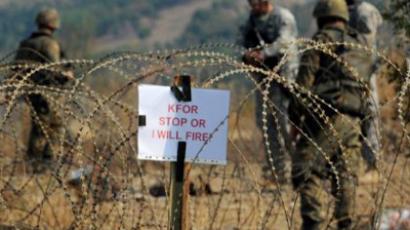
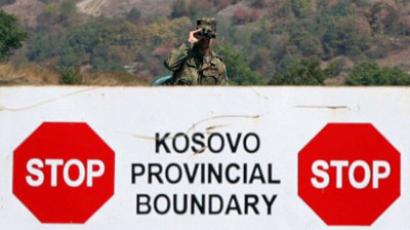
Kosovo Force KFOR soldiers guard the border crossing Jarinje between Serbia and northern Kosovo (AFP Photo / Dimitar Dilkoff) 30.09.2011, 14:50 67 comments

NATO issues Kosovo shoot-to-kill warning

Violence has flared again in Northern Kosovo after NATO troops brutally dispersed a crowd of Serbian protesters at a makeshift roadblock, firing live ammunition at peaceful demonstrators, and have now established an armed presence in the area.

Serbia, Jarinje: A man looks at KFOR soldiers standing guard at Jarinje border crossing between Serbia and Kosovo on July 29, 2011. (AFP Photo / Sasa Djordjevic) 29.09.2011, 18:54 6 comments

Kosovo barricades grow while UN fiddles

Talks on Kosovo at the UN Security Council are deacllocked with members failing to agree a common stance on the volatile situation. Meanwhile, local Serbs are continuing to reinforce barricades near the disputed Serb – Kosovo border.

German troops serving in the NATO-led peacekeeping mission (KFOR) in Kosovo on September 28, 2011 (AFP Photo / Armend Nimani) 28.09.2011, 21:12 15 comments

NATO provoking another conflict in Balkans - Rogozin

NATO peacekeeping force KFOR has sent more troops to the Serbian-Kosovo border following bloody clashes there. But as Russia’s envoy to NATO Dmitry Rogozin told RT the alliance is creating a new conflict in the region.

Serbia, Jarinje: A German KFOR soldier stands guard at the Jarinje border crossing between Serbia and Kosovo. (AFP Photo / Sasa Djordjevic) 27.09.2011, 20:27 26 comments

Clashes on Serbia-Kosovo border: 11 wounded

A NATO spokesperson has confirmed that its troops fired on Serb protesters in the Mitrovica region. According to the statement, they were responding to an attack by the crowd.

Kosovo Force KFOR soldiers guard the border crossing Jarinje between Serbia and northern Kosovo on September 16, 2011 (AFP Photo / Dimitar Dilkoff) 16.09.2011, 22:50 19 comments

EU, Kosovo take over disputed Serbian border checkpoints

Kosovo's prime minister announced that the breakaway region has introduced customs control on its border with Serbia, a move strongly opposed by Belgrade. Local Serbs have been trying to prevent it by blocking roads leading to the two border posts.

Caged in: Kosovo Serbs barricade for freedom

Published: 09 November, 2011, 10:00

A concrete reinforced barricade in front of the main bridge, one of the two bridges built between the south, the ethnic Albanian-dominated part and the north, the Serb-dominated part of Mitrovica. October 2, 2011 (AFP Photo / Str)

(28.5Mb) embed video

TAGS: Breakaway regions, Conflict, Military, Kosovo, Aleksey Yaroshevsky, Sean Thomas, The Balkans


For months, Serbs in Northern Kosovo have been putting up barricades against the hated Kosovo authorities as well as NATO peacekeepers. Little by little, they are growing accustomed to living in a cage of their own creation.

­The barricades on the border are perhaps not an obvious venue for a wedding, but as RT’s Aleksey Yaroshevsky reports, one Serbian couple living in the Northern Kosovo town of Mitrovica has decided that this was where they would tie the knot.

“We gathered together here and danced our joyful wedding dance,” says Dejan, a local resident who was among the guests.

“This is our land and this is our way to underline that – Kosovo is Serbia.”

The Serb barricades in Northern Kosovo have been standing for several months now. For those who built them, they are just a part of everyday life. Not only have the Kosovo Serbs isolated themselves from the KFOR troops, but also from their unwanted neighbors.

The UN head has voiced concerns over a rise in attacks on the minority Serb population and their property in Northern Kosovo. Ban Ki Moon put part of the blame on the decision of the Kosovo Albanian leadership to extend its control over the predominantly Serbian area.

The famous bridge in Mitrovica, which splits the town into Serbian and Albanian neighborhoods, was called the bridge of friendship and was meant to symbolize the good relations between the two sides. But the size of the barricades on the Serbian side now tells the whole story about their unwillingness to be part of the self-proclaimed state of Kosovo.  

While the cemented barricades in Mitrovica have become the town’s main gathering spot, tensions are still running high just a few kilometers away. For every Serb-built sand heap that KFOR troops manage to demolish, stubborn Serbs build two new piles. There are times when the two processes take place simultaneously.

“We will protect our land with our bodies,”
a Serb woman says. “We are the kind of people who never give up.”

Serbs say they have no choice but to continue barricading themselves in: they believe the Kosovo Albanians would not hesitate to wipe them off their land – forcefully helped, they believe, by KFOR troops.

­Getting used to life in a cage

­Despite constant clashes with the NATO contingent and political pressure from Belgrade, the Kosovo Serbs have become accustomed to living in the cage they have built for themselves.

“It was hard at first, when we ran out of food and petrol,” says Krstimir Pantic, mayor of Mitrovica.

“But we Serbs are people who are used to improvising and finding a way out. We’ve built alternative routes through the mountains, so now we can again receive supplies. We have prevented a humanitarian catastrophe.”

Father Milia, an Orthodox priest in the town’s brand-new temple, says he has never been busier, with all the people flocking in lately to pray for the wellbeing of their families.

“Kosovo has seen a succession of hard times, even being occupied by Turkey at one point. But our monasteries withstood all those hard tests of time,” Father Milia argues. “And everyone in Mitrovica knows – this land is the cradle of Serb culture and statehood.”

Meanwhile, the deadlock in this Balkan melting-pot continues. Belgrade remains unwilling to resume negotiations with Pristina which could put paid to this stand-off.  

But while politicians clash, children from Serb families live and play near the barricades, and even though they might be too young to realize what it is all about and why they are being shown the barriers, there is little doubt what views they will inherit once they grow up.


+12 (22 votes)
 
Back to top
next MORE NEWS
The last similar encounter happened in 1976, although astronomers did not know about the flyby at the time. 09.11.2011, 04:29

Close shave: Titanic-sized asteroid brushes past Earth

A huge asteroid, almost half a kilometer in diameter, swept past Earth on Tuesday night. This was the closest approach in 35 years by a cosmic object, as big as an aircraft.

Young Indian children stand by a make-shift home by the roadside in Mumbai (AFP Photo / Sajjad Hussain) 09.11.2011, 11:07

New ‘poverty standards’ enrage Indians

The Indian government has announced a drop in the number of poor people in the country by massaging the criteria used to measure poverty. By its reckoning, less than a dollar a day is enough to get by – but the numbers don’t tell the whole story.

O3PEHKO November 10, 2011, 21:50
+3


"It may take a thousand years for the Serbs to wake up and realize they lost Kosovo from their own selfish aggression."
Aggression?  Do you even have a clue as to the meaning of this word?  Are you saying that Serbia invaded Kosovo during the war?  If so, maybe you would like to explain to us how it is possible for a country to invade itself.  
"but, in the end they lost Kosovo."
False.  Read UN Resolution 1244 which defines Kosovo as a part of Serbia.  Also, the majority of countries have NOT recognized Kosovo as an independent state.  Just because a breakaway province decides to unilaterally declare independence does not automatically render it an independent state, even if a country as powerful as the United States decides to recognize it.  

O3PEHKO November 10, 2011, 21:34
+4

David, drawing any comparison with Kosovo to what happened in Nazi Germany is really idiotic on your part.  
"Hard to feel sorry for Serbs when they created the entire situation in the first place."
Do you want to explain how it is that Serbs created the entire situation?  What situation are you referring to specfically?  This is a blanket statement, and serves no basis in proving your argument that is illogical from every perspective.  As far as I know, if a group of armed separatists with ties to drug cartels decides to carry out acts of terrorism against a population and the institutions of a nation, then that nation has every right to defend its own people by pre-empting any further violent attacks.  
"Kinda like feeling sorry for Germany post WWII."
What evidence do you have to support this ridiculous claim?  The number of Serbs in Kosovo has dwindled to an all-time low since this region became a cradle of Serbian civilization.  You really ought to do some research and learn to analyze information instead of merely regurgitating whatever false claims you heard in the mainstream media dating back to the Kosovo War.  


Perunova straža November 10, 2011, 12:59
+6

@ David: There was no ethnic cleansing in Kosovo and Metohia other than cleansing of Serbs done by Albanians and in recent years helped by NATO.
Exactly how on nation can commit aggression against its own land is beyond me.

Comparing Serbs which lost quarter of the population fighting Nazis in WWII and being victims of genocide to the same Nazis is out of place.

NATO and Albanian mafia are the main and only generators of violence and conflict in Kosovo and Metohia.
Only way to bring back peace, democracy, stability and human rights to troubled southern province of Serbia is to finally allow return of police and military of Republic of Serbia, which is guaranteed by the UN Resolution 1244, and let security forces finally deal with terrorists and mafia.