VERSIONS: روسيا اليوم NOTICIAS FREEVIDEO ИНОТВ RTД
breakingnews
Go to main page   News   Kazakh leader learns lessons from Gaddafi’s experience  
MORE ON THE STORY
Kazakh President Nursultan Nazarbayev and his wife cast their vote at a polling station during the presidential election (RIA Novosti / Vladimir Buharevich) 15.01, 09:46 1 comment

Kazakhstan elects new parliament

Polls have officially closed in the western-most region of Kazakhstan following Sunday’s parliamentary elections. Doubts remain whether any party other than the ruling one will clear the threshold necessary to take seats in the legislature.

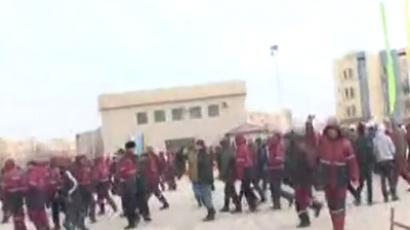
Kazakhstani authorities have deployed army units and armored vehicles to the town of Zhanaozen to contain a thousand-strong protest (image: frame fom Zhanaozen riot footage) 16.12.2011, 23:06 14 comments

Kazakhstan quells riots amid news blackout

The Kazakh president has enforced a 20-day state of emergency and an evening curfew in the town of Zhanaozen. Police arrested some 70 people over the violent uprising, which left at least 11 people dead and more than 80 injured.

Police detain a participant in the mass disorder in the city of Zhanaozen, western Kazakhstan (RIA Novosti / Anatoliy Ustinenko) 18.12.2011, 10:08 7 comments

Kazakh police open fire on rioters

Kazakh police have opened fire on protesters in the western part of the country as fresh violence has flared following mass riots in the oil city of Zhanaozen. One person is reported killed and eleven injured according to the prosecutor’s office.

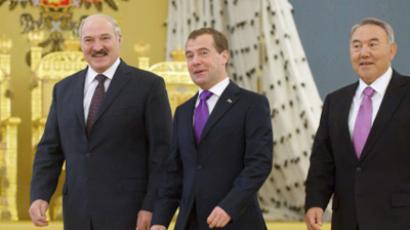
Dmitry Medvedev, Alexander Lukashenko and Nursultan Nazarbayev meet in Kremlin (RIA Novosti / Dmitry Astakhov) 20.11.2011, 04:55 4 comments

What can Eurasian Union learn from EU troubles?

As Russia, Belarus and Kazakhstan move a step closer to a Common Economic Space, a union bearing similarities with the EU, could they run into the same troubles? The man at the heart of the matter explained to RT how to avoid pitfalls.

Eurozone crisis
Egyptian soldiers beat-up a protester during clashes near Cairo's Tahrir Square on December 16, 2011 (AFP Photo / Mohammed Abed) 31.12.2011, 22:32 6 comments

The year of dissent: The Arab Spring

The protests are still raging across the Arab world as the year 2011 ends. Despite the fact that some autocratic rulers have already been removed from power, it seems others are on the waiting list as the Arab Spring shows no signs of easing up.

Egypt unrest Arab world protests

Kazakh leader learns lessons from Gaddafi’s experience

Published: 15 January, 2012, 13:45

View of Astana. Monument "Astana-Baiterek" (center) (RIA Novosti / Ekaterina Chesnokova)

(31.2Mb) embed video

TAGS: Natural resources, Oil, Election, Protest, Politics, Oksana Boyko, Cary Johnston, Libya, Gaddafi, Gas, Kazakhstan


Early parliamentary election in Kazakhstan comes just a month after the country was shaken by deadly riots in the town of Zhanaozen. And the time seems right for change in a country that does not want to follow in its restive neighbors’ footsteps.

­If it was not for the snow and the freezing temperatures, Kazakhstan's capital of Astana could easily be mistaken for one of the gleaming cities of the Persian Gulf. A village just two decades ago, it is now an oasis in the desert, with its architecture having a distinct Arabic flavor.

Like many Arab countries, Kazakhstan's primary source of income is oil and gas, and it is these exports that have allowed this country the luxury of building a new capital city from scratch in less than 20 years. In fact, Kazakhstan is now producing about as much oil as Libya used to churn out prior to the civil war, and the similarities between the two countries do not end there.

Both Kazakhstan and Libya have predominantly Muslim populations. Both were considered stalwarts of calm in their turbulent neighborhoods. And both have experienced decades of rule by just one man. In terms of style, steadfast Nursultan Nazarbayev is the exact opposite of erratic Muammar Gaddafi, and of course he is still in power.

But the Libyan scenario no longer seems improbable in Kazakhstan, even to its leader.

“Some young people are fascinated with what's happening in the world right now: in Africa and Europe. But we have to explain to the new generation that blindly believes everything it's told that there are those who envy us and our well-being,” President Nazarbayev once said. “The countries where revolutions took place have gone back 10 to 15 years, economically speaking.”

The town Zhanaozen is rightfully called Kazakhstan's oil capital, but it is no match for glistening Astana. Despite producing much of the country's hydrocarbons, for decades it has been poor and neglected.

The uprising in western Kazakhstan has smoldered since last spring, but culminated last December in a weekend of clashes with police that left 17 dead and more than 100 injured. As the protests spread to other cities, the authorities were jittery in the wake of the Arab Spring.

“What happened in Arab countries definitely scared Kazakh authorities,” says Bolat Abilov, a member of the opposition. “The first thing they did when the uprising began was to switch off mobile networks and the internet connection.”

Before the people even demanded it out loud, the Kazakh authorities decided to offer political reforms. The people are now going to the polls to elect a new parliament. Recent constitutional amendments guarantee there will be more than one party, which there has been up until now.

“The challenge now is to keep all the good things – stability, prosperity, and at the same time allow the society to evolve,” Ariel Cohen of the Heritage Foundation told RT.

Meanwhile, the authorities have approved millions of dollars worth of programs to give the restive city a face-lift and create new job opportunities. The president's close associate, Baurzhan Mukhamedzhanov, who was appointed to oversee the turbulences, says that in a few years, Zhanaozen will make some cities in the gulf pale in comparison.

“Come here in a few years… and you won't recognize this city,” he said.

While the Arab spring may have sparked protest movements around the world, it has also taught many countries how to deal with them. Kazakhstan is trying to show it has learnt those lessons – and its leaders hope it will remain a stable presence in an unstable world.


+3 (3 votes)
 
Back to top
next MORE NEWS
Iranian navy conducts the "Velayat-90" naval wargames in the Strait of Hormuz in southern Iran (AFP Photo / EBRAHIM NOROOZI) 15.01, 13:05 62 comments

Iran Wars Episode 1: The gulf menace

Iran plays a critical role in the Persian Gulf and, with its strategic geography, totally dominates the northern gulf and the Strait of Hormuz. But does it have enough resources to block and hold the strategic route in the event of military conflict?

Iran tension
Syrian President Bashar al-Assad (AFP Photo / SANA) 15.01, 14:00 17 comments

Syria's Assad grants general amnesty 'for uprising crimes'

President Bashar al-Assad has issued a decree granting general amnesty for crimes committed during the Syrian uprising which started in March 2011, the official government news agency SANA reported on Sunday.

Syria unrest
Nay Lin Maung January 16, 2012, 05:04
0

It is very sad to see senior Sir Mr. Gaddafi passed away.


It is good new for the people of the Kazakh because they elect the new people who can work for their needs.


unison January 16, 2012, 01:08
-1

Gaddafi experience? So there is a chance he and his family could be dragged out of a sewage pipe, sodomized and summarily executed? Really? Then why didn't the CSTO march into Kazakhstan to crush these terrorists? Or does Russia want to lose another ally and member of the Eurasian Union?

neocon-spins January 15, 2012, 20:42
+2

The only Western expert that “fits” for RT report in this case is Ariel Cohen with the Heritage Foundation- the mother of all things neocon. But do RT global English readers know this? I think not.