VERSIONS: روسيا اليوم NOTICIAS FREEVIDEO ИНОТВ RTД
breakingnews
Go to main page   News   All Fukushima-1 reactors to be scrapped – Japanese government  
MORE ON THE STORY
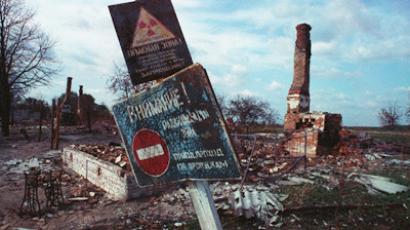
Chernobyl ruins (Photo by Igor Kostin) 16.03.2011, 09:04 2 comments

World considers nuclear-free future

The Japanese disasters have raised questions as to whether nuclear technology can ever be called safe to use. EU nuclear experts are considering if the union should eventually move away from nuclear energy.

Earthquake in Japan Fukushima nuclear disaster
In a handout picture released by Greenpeace and taken on March 27, 2011 shows a Greenpeace team member holding a Geiger counter displaying radiation levels of 7.66 micro Sievert per hour in Iitate city, Fukushima. (AFP Photo / Christian Aslund) 29.03.2011, 12:49 3 comments

State of alert raised to highest level at Fukushima

The Japanese government has raised the state of alert level at the Fukushima-1 nuclear plant to the maximum. The Japanese Prime Minister Naoto Kan addressed the nation, saying the situation remains “unpredictable”.

Earthquake in Japan Fukushima nuclear disaster
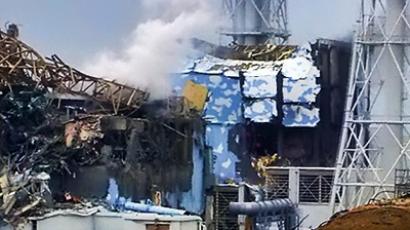
Destroyed building of TEPCO's Fukushima Daiichi (No. 1) atomic power plant (AFP Photo / HO / Nuclear and industrial safety agency VIA JIJI Press) 26.03.2011, 11:45 2 comments

Difficult to predict end of Fukushima crisis – Japanese spokesman

Japan’s continuing efforts to cool reactors at the Fukushima number 1 nuclear plant are being repeatedly impeded by the wavering radiation levels. However, work that was suspended due to high radiation levels earlier on Saturday has been resumed.

Earthquake in Japan Fukushima nuclear disaster
This handout picture released by Tokyo Electric Power Company (TEPCO) via Jiji Press on March 21, 2011 shows black smoke rising from reactor number three of the number 1 Fukushima dai-ichi nuclear power plant at Okuma town in Fukushima prefecture (AFP Photo / HO / TEPCO via Jiji Press) 22.03.2011, 11:21 2 comments

Radiation level at Fukushima exceeds norm 1,600 times – IAEA

Work has resumed at the Fukushima power plant after it was interrupted for the second time in 24 hours. Restoration work has been underway at the facility to deal with damage caused by the tsunami.

Earthquake in Japan Fukushima nuclear disaster
Japan: Damaged third (L) and fourth reactors of the TEPCO Fukushima No.1 power plant in Fukushima, north of Tokyo (AFP Photo) 21.03.2011, 12:58

Smoke forces evacuation at Fukushima reactor

Workers have been evacuated from one of the reactors at the disaster-stricken Fukushima nuclear plant after it emitted gray smoke, prompting fresh concern over a potential radiation leak. Shortly after, white smoke was seen over another reactor.

Earthquake in Japan Fukushima nuclear disaster

All Fukushima-1 reactors to be scrapped – Japanese government
Published: 30 March, 2011, 14:36
Edited: 31 March, 2011, 03:41

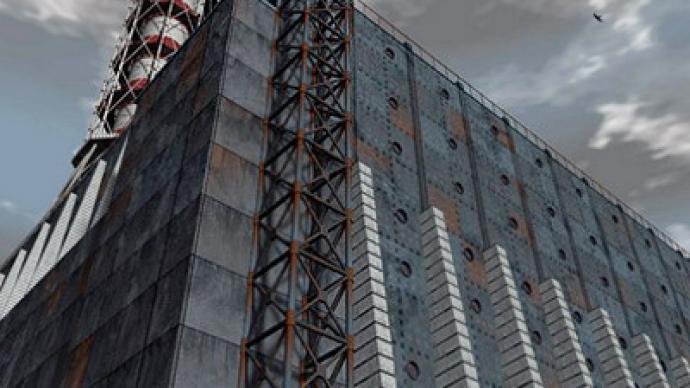
The sarcophagus over Chernobyl reactor (Image from news.kievukraine.info)

(1.8Mb) embed video

TAGS: Ecology, Health, Natural disasters, Nuclear, Accident, Japan


The Japanese government has decided to decommission all six reactors at the damaged Fukushima nuclear power plant. TEPCO is also considering the construction of a containment shell at some of its reactors.

­Earlier on Wednesday, Tsunehisa Katsumata, a chairman of TEPCO, said the company saw scrapping its four most troubled reactors as inevitable, Kyodo News reports.

However, Yukio Edano, the chief cabinet secretary and top spokesman in the Kan government, went further and suggested that all of the reactors at the Fukushima plant should be scrapped.

''It is very clear looking at the social circumstances. That is my perception,” Edano said to a news conference, as quoted by Kyodo News.

In addition, TEPCO is planning to cover the damaged units with a special containment shell made of a high-tech fabric. This cover is aimed at preventing radioactive particles from escaping into the atmosphere, Asahi Shimbun newspaper reports.

Specialists will first apply a unique compound onto all four reactors, to prevent radioactive particles from escaping into the atmosphere, and then will cover units 1, 3 and 4 with the fabric, to enforce the protection.

This decision echoes the steps that Soviet specialists had to undertake in the case of the Chernobyl reactor. It was eventually sealed off within a massive concrete tomb called the sarcophagus. The catastrophe provided valuable lessons in how to deal with a reactor disaster, but also stern warnings about the dangers of nuclear energy.

Japanese workers have been unsuccessfully trying to restore the cooling system at the Fukushima facility, in what is now the worst atomic crisis since Chernobyl. The level of radiation measured in seawater near the site, is now said to be around 3,500 times higher than normal.

­Professor Christopher Busby, of the European Committee on Radiation Risks, says that what we are witnessing in Japan is even worse than Chernobyl and prabably be an end to nuclear industry worldwide.

“I have said right from the beginning that this was a Chernobyl-level disaster,” he said. “I would hope that it means that the nuclear industry is finished. In my opinion, it is going to finish the north of Japan off.  I don’t see what they can do about it. They are going to have a very large exclusion zone, and the cost is going to be absolutely phenomenal, so the nuclear industry is finished. But then I thought about Chernobyl and what happened there – there was a massive international cover-up by the nuclear lobby of all the health effects of the Chernobyl accident, which is only coming out now.”


embed video

­John Large, an independent nuclear consultant, says that Tepco has begun to take control of the Fukushima-1 site, a week after they should have, and now the worldwide community might learn the real scale of the contamination and spread of radiation.

The Japanese believed this cascade from the earthquake and tsunami could never happen, or would happen so infrequently that they did not have to take account of it,” he said. “And as a result they never practiced it, never rehearsed for this type of accident. We saw the Japanese for the first two weeks running around like headless chickens not knowing what to do. The real problem is this: if you take a measure, like flooding the reactor with water, that may only lead to serious consequences later on, when they have all the accumulated water offsite which is highly radioactive. Then you will have to make a decision on how to deal with the water: Will you keep it inside in trenches, or discharge it into the sea with consequences for the marine environment? So, whichever way they turned, they have been ill prepared and they poorly planned for the consequences of their succeeding actions.”

The consequences are going to be disastrous if compared to Chernobyl’s tragedy in 1985, Large argues, as Fukushima-1 is a bigger facility than Chernobyl was. Fukushima-1’s crisis involves three reactors, while Chernobyl’s tragedy involved only one. Moreover, Large added, “there were very heavy actions taken by the Soviets at the time to try and control the situation in an ordered way. Here we have disorder and chaos.


embed video

+9 (11 votes)
 
Back to top
next MORE NEWS
Yury Gagarin (RIA Novosti / Aleksand Mokletsov) 30.03.2011, 14:31 1 comment

Gagarin’s undelivered death note published

A letter written by Yury Gagarin to his wife and daughters, penned two days before his potentially fatal journey into space, has been published.

Image from meditation-portal.com 30.03.2011, 16:57 2 comments

First-ever shot of Mercury taken from its orbit

The first-ever photograph of Mercury taken from the planet’s orbit has been delivered by NASA’s Messenger spacecraft, which entered the planet’s orbit earlier this month.

konsyltacii September 08, 2011, 10:31
0

In English:


In Japan, as in other countries, there is a logical chain of "cause - result". There is an analysis of the causes and consequences (results) for different countries.  Portions of analysts are published online in blogs of konsyltacii.

SaintlyMic April 06, 2011, 02:07
0

This nuclear tragedy in Japan is very sad, and is unexpected.
I have heard for years that the Japanese are ahead in nearly every aspect from schooling to science.
This nuclear disaster is showing the complete opposite.

The leaders of Japan have proven to be unable to lead during this crisis.

Japan has shown itself to be inconsiderate, arrogant, high minded, selfish, self serving, and deceptive.
It would seem the Japanese would have learned from their mistakes of WWII, but it is glaringly obvious that they have not.

I still pray for them today.
They need Jesus more than ever now.
I pray they will now let others take over and let them repair the dire damages the Japanese have done.