VERSIONS: روسيا اليوم NOTICIAS FREEVIDEO ИНОТВ RTД
breakingnews
Go to main page   News   Italian crisis: Impossible to overcome while inside eurozone?  
MORE ON THE STORY
Anti-austerity protesters hold a Greek flag reading 'not for sale' during a student parade in Athens, attended by the Greek minister of education (AFP Photo / LOUISA GOULIAMAKI) 13.11.2011, 19:07 11 comments

Socializing losses: Trilateral takeover of Europe?

The sovereign debt crisis tightening its grip on Europe has claimed the scalps of two prime ministers – those of Greece and Italy. Looking at the men poised to replace them, one cannot but ask – is this another turn of the screw for ordinary people?

Eurozone crisis
Italian Prime Minister Silvio berlusconi reacts during a session at the parliament to adopt measures he promised to the European Union on November 12, 2011 in Rome (AFP Photo / FILIPPO MONTEFORTE) 13.11.2011, 00:52 7 comments

Ciao, Silvio! Berlusconi resigns as Italian PM

Italian Premier Silvio Berlusconi has resigned on Saturday bringing an end to a 17-year political era, after parliament's lower chamber passed European-demanded reforms.

Eurozone crisis
A demonstrator holds a banner bearing the face of Italian Prime Minister Silvio Berlusconi and reading "Throw the shoe at Silvio" during a protest  on November 11, 2011 (AFP Photo / Filippo Monteforte) 12.11.2011, 12:16 3 comments

Cheerio Silvio!

The era of Silvio Berlusconi may come to an end in a matter of hours, as the Italian parliament has approved the austerity law in a final vote.

Eurozone crisis
Pro-communist union protesters shout slogans in front of the Greek parliament during a demonstration in central Athens on November 10, 2011 (AFP Photo / Aris Messinis) 11.11.2011, 19:59 3 comments

‘EU is showing its true nature as a dictatorship’

This is a time of upheaval for the EU, with both the Greek and Italian PMs giving up their posts. The Paris Institute's John Laughland says that this undemocratic transfer of power is not going to save the euro.

Eurozone crisis
AFP Photo / Filippo Monteforte 11.11.2011, 09:51 5 comments

Italy: New government, old problems

Italian Prime Minister Silvio Berlusconi is making final preparations to say “arrivederci,” but even as Italy prepares to form an emergency government, doubts remain that a new captain will manage to steer the Italian mega-yacht to a safe haven.

Eurozone crisis
Nicolas Sarkozy (AFP Photo / Lionel Bonaventure) 10.11.2011, 15:40 6 comments

‘Sarkozi’s head to roll next – probably’

Though France currently boasts an AAA rating and has its debts under reasonable control, domestic issues could knock it off its perch sooner rather than later, argues Hamish McRae, chief economic correspondent of The Independent newspaper.

Eurozone crisis
Demonstrators wearing masks of Italian Prime Minister Silvio Berlusconi (R) and the leader of the Northern League Umberto Bossi on November 5, 2011 in Rome (AFP Photo / Andreas Solaro) 10.11.2011, 10:52 6 comments

Italian job: Can Europe break fall of Rome?

The eurozone crisis is developing at an unprecedented rate and Italy has become the latest country to be sucked into a debt spiral from which it might not return.

Eurozone crisis
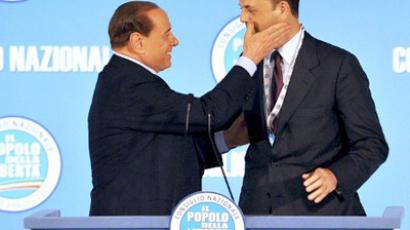
Italy, Rome: Italy's Justice Minister and new general secretary of the ruling party Partita della Liberta  Angelino Alfano is greeted by Italian Prime Minister Silvio Berlusconi during a meeting of the PDL on July 1, 2011 (AFP Photo / Alberto Pizzoli) 09.11.2011, 19:58 2 comments

The end of the Berlusconi era for Italy

Berlusconi has named as his likely successor a former justice minister, Angelino Alfano, who gained notoriety for going above and beyond the call of duty in his efforts to keep the Italian Prime Minister immune from prosecution.

Eurozone crisis
Italy's Prime Minister Silvio Berlusconi reacts prior a vote on Italy's public accounts at the parliament on November 8, 2011 in Rome (AFP Photo / VINCENZO PINTO) 08.11.2011, 23:03 6 comments

Addio Silvio! Berlusconi plays last hand

Italian President Giorgio Napolitano has announced the country’s long-ruling Prime Minister Silvio Berlusconi will step down from his position after austerity measures are approved.

Eurozone crisis

Italian crisis: Impossible to overcome while inside eurozone?

Published: 13 November, 2011, 23:24

European Competition Commissioner Italian Mario Monti (AFP Photo)

(41.1Mb) embed video
TRENDS: Eurozone crisis

TAGS: Markets, EU, Interview, Crisis, Politics, Europe, Currencies, Rory Suchet, Economy, Finance, Greece


Silvio Berlusconi's party agreed that former EU commissioner Mario Monti should try to form a short-term government. This, however, will not help Italy emerge from the crisis while it is part of the eurozone, according to writer Charles Crawford.

­Italy's President, Giorgio Napolitano, is holding meetings with senior politicians to form a caretaker government.  But according to writer and private consultant Charles Crawford, the problem is there are many factors affecting Italy that are not really under its control because it is in the Eurozone, and therefore it cannot avert financial disaster.

“One of the things they have to do is satisfy certain objective targets, namely finding a plan to pay back the money they owe to investors round the planet. The other thing they have to do is come up with subjective factors, namely to have people in charge of Italy who are convincing and credible. I think it is fair to say that Berlusconi had stopped being convincing and credible and Monti looks like a good choice,” he explained.

Greece has also installed a new government and a new Prime Minister, but simply changing the faces in power will not necessarily make much difference, believes Crawford, who says there are obvious similarities between Italy and Greece.

“All the countries in the eurozone which are getting these debt difficulties are having the same problem. This is because they are in the eurozone and cannot devalue their currencies. In effect they are left with borrowing money from the international market and the other eurozone members. They are left with reducing government spending, which is sacking people, which is not popular with the people who are sacked. They are reduced to putting up taxes, which is not popular with everyone else," he explained.

“Once you’ve got into these very strong difficult debt situations, the ways out are all very painful. So in both Greece and Italy and in some other eurozone countries the choices available to the leaders of the countries concerned are very limited. That is why the eurozone is coming under stress – because the political and psychological pressures are coming up against the way the whole thing was set up in the first place,” he added.

Crawford emphasized that the crisis in Europe is like an impressive house where the foundations, it turns out, were not very well built. And it is very difficult to repair the foundations while inside the house and without moving somewhere else.

“And the euro members cannot go anywhere else,” he said. “The eurozone is coming under stress – you can see this would not have been happening two or three years ago. It is going to be very difficult, I do not think there will be any easy options. The option that most people seem to favor is that the European Central Bank should print a lot of money, but there are clear policy problems with doing that on the scale required. Europe has to find a way to become a lot more credible.”

Patrick Young, Executive Director of the investment firm DV Advisors, said that changing the prime minister will not immediate solve Italy’s problems – as its real problem is a huge amount of debt, which it needs to sell in the near future.

“The markets have lost faith not just in Italy, but in Europe’s so called political leadership, who are doing anything but leading,” he told RT.

As for Greece, it must default on its debt to get a “wholesale restructuring.” But at the root of the problem are banks in France and Germany, which do not want to lose their money, he said.

“Greek people need to secure their own destiny and decide what they want to do, because piling austerity on austerity is just going to lead to more militancy and, tragically, people starving in the streets.”



embed video

0 (1 votes)
 
Back to top
next MORE NEWS
Syrians protest outside the Qatari Embassy in Damascus on November 12, 2011, hours after a statement, read by Qatari Prime Minister Hamad bin Jassem Al-Thani, said the Arab League had decided "to suspend Syrian delegations' activities in Arab League meetings" and to implement "economic and political sanctions" against Damascus (AFP Photo / LOUAI BESHARA) 13.11.2011, 22:23 9 comments

Syrians furious over looming Mideast isolation

As massive pro-Assad demonstrations continue across Syria, Damascus has called for an emergency meeting of Arab League heads of state in an apparent attempt to avert its suspension from the regional bloc.

Syria unrest
Stacks of twenty dollar bills pass through on machine at the Bureau of Engraving and Printing in Washington, DC. (Mark Wilson/Getty Images/AFP) 14.11.2011, 05:34 8 comments

‘US is a declining power and has trouble adjusting’

The APEC summit in Honolulu revealed sharp divisions between the US and China, US growing critical over Beijing's control of the value of the Yuan. But experts believe it could take over as the world's reserve currency if China can meet expectations.

Eurozone crisis US debt crisis
ABDELKADER HAMDAOUI November 18, 2011, 21:55
0

The bottom line is not only that Greece, Italy and especially Spain must learn (how) to export more than they import and to spend less than they earn but to get rid of their antediluvian bureaucracies that hitherto circumscribed people's spirits and creativity, work ethics, resourcefulness and enthusiasm and therefore actual economic progress. In Britain a couple of 18 year olds can constitute a limited company (or even a plc) to do business in less than 24hours with less than £100 without the need of a lawyer or the dreaded 'notary' and the permission of the so-called democratic authorities. Laws in Greece, Italy, Portugal and Spain have to be radically revamped and if possible do away with the older generation who are holding onto power. People in these countries would be much better off only if they could manage to feel less entitled and proud, for they have nothing to be proud of, and adopt some humility. Pride goeth before a fall and they fell flat on their faces.  

Nay Lin Maung November 15, 2011, 00:37
0

In this case, the leadership of the Greece and Italy have to ask for their compensate being part of the euro zone to lose their monetary policies.

Christian (unregistered) November 14, 2011, 15:30
0

The difference between countries like UK and Italy is just the currency i the UK´s case the pound will loose some of its value and possibility for a export based rebound exists while Italy has the euro which will remain the same thus forcing them into a Greek style debt increase coupled with a steadily shrinking economy.