
VERSIONS: روسيا اليوم NOTICIAS FREEVIDEO ИНОТВ RTД
breakingnews
Go to main page   News   IMF and World Bank’s aid tightens noose around poor nations  
MORE ON THE STORY
RIA Novosti / Dmitriy Astakhov 14.04.2011, 09:42 2 comments

BRICS summit pushes for IMF reform

BRICS leaders have agreed to prepare a package of proposals concerning the reform of the International Monetary Fund and the World Bank, President Dmitry Medvedev announced during a summit of the “big five” in China’s Sanya.

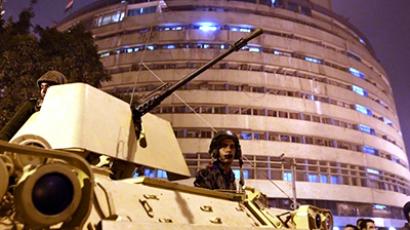
Egypt, Cairo : Members of the Egypt's President Hosni Mubarak Republican Guard deploy outside the national television building in Cairo on January 28, 2011.  (AFP Photo/Khaled Desouki) 28.01.2011, 23:45 3 comments

US eyes Middle East unrest with own interest in mind

Protests inspired by the revolt in Tunisia have dominoed along Egypt, Yemen and Algeria with citizens calling for governmental change. What will this mean for US involvement in the region?

Egypt unrest
15.12.2010, 14:18 1 comment

By the banks, we sat down and wept

As a wave of public demonstrations over austerity measures sweeps Europe, it is the role of the banking system in the lead up to the financial crisis which needs to be considered.

China’s annual economic forum in Boao (RIA Novosti / Michail Klimentyev) 15.04.2011, 08:28 2 comments

China’s Davos: fairer economies for stronger politics

China’s annual economic forum opened on Friday in the city of Boao in the wake of the BRICS summit, gathering politicians and business leaders from all over the world to promote Asia’s role in global finance and politics.

IMF and World Bank’s aid tightens noose around poor nations

Published: 15 April, 2011, 10:12
Edited: 15 April, 2011, 14:17

Cracked piggy bank

(13.2Mb) embed video

TAGS: Marina Dzhashi, Marina Portnaya, Banking, Finance


The help provided by the World Bank and International Monetary Fund to debt-stricken countries is aimed at aiding their recovery, but it seems to be dragging them deeper into trouble.

­The International Monetary Fund (IMF) provides loans and influences policy changes of borrowing countries. But economist Mark Weisbrot from the Center for Economic and Policy Research says the neo-liberal measures pushed by the institution often cause more damage than good.

They’re looking out for the interest of the creditors,” says Mark Weisbrot. “Right now, the IMF is very heavily involved in Europe, even when they’re not loaning money. In Ireland, Spain, Portugal, Greece, Latvia, Estonia, the IMF is working with the European authorities and a lot of these countries are not going to recover for as much as ten years.”

Public frustration with rampant unemployment, high food prices and privatization deals is believed to have helped spark the mass uprising in Egypt. At the suggestion of the IMF and World Bank, ousted President Hosni Mubarak sold public companies to local and foreign investors, while 40 per cent of Egyptians earned US$2 per day.

It’s definitely a catalyst and the timing is very much related to what was tremendous financial deregulation and opening to privatization by external banks of Egypt and other countries and what has had dramatic negative circumstances,” says author and journalist Nomi Prins.

Egypt may eventually go the way of Latin America, where socially oriented governments have rejected the IMF’s neo-liberal policies after decades of economic struggle.

You had this long period, from 1980 to 2005, where it was a huge failure in Latin America, in Africa, in places where the IMF was most involved. You had an unprecedented economic failure,” says Mark Weisbrot.

Since its inception, the World Bank’s president has always been an American, the IMF director always a European, despite the 187 nation membership.

Former IMF chief economist Simon Johnson believes the US pulls the strings.

The World Bank and the IMF are located three blocks from the White House for a reason. It was the structure of political and economic power in 1944 and 1946, and that’s the primary structure of power in the world today,” says Simon Johnson.

Five of the largest emerging nations in the world are now demanding an end to the Western monopoly over the global institutions. Brazil, Russia, India, China, and South Africa – known as BRICS – say leadership of the IMF and World Bank must reflect the changes of the global economy, a transformation from club-based to all-inclusive.


+7 (7 votes)
 
Back to top
next MORE NEWS
Terrorists’ ally on trial in Finland for smuggling Chechens 15.04.2011, 10:10 4 comments

Terrorists’ ally on trial in Finland for smuggling Chechens

The publisher of a Helsinki-based website that supports Chechen terrorists, Mikael Storsjo, has gone on trial in Finland accused of illegally smuggling Chechens into the country.

Global terrorism
British private security guard (L) on duty in Iraqi government building, Baghdad 7 July, 2004 (AFP Photo / Saeed Khan) 15.04.2011, 12:28 6 comments

Libya: blood bonanza for contractors

Libya might soon turn into a goldmine for private security firms. Reports say that the UK is already hiring mercenaries to protect the interests of the big corporations there, once Colonel Gaddafi goes.

Libyan conflict
Marzipan6 April 17, 2011, 07:47
0

Amsterdam, I think what you meant to say was that there is always a human being at the head of human organisations, complete with human strengths and weaknesses. Just as there is always a human being that originates submissions to the RT form, complete with human insights and biases, one of which includes racism.

Amsterdam April 16, 2011, 16:23
0

Well, there's always a jew at the head of these organisations.

MEJanssen April 16, 2011, 06:54
0

Lots of people are convinced the purpose of the "aid" from the IMF is not to help countries but to enslave them.  Those "loans" come with very painful chains, and countries are bound for decades trying to pay the debt off.  Sometimes the aid leads to government destabilization, when the citizens revolt against draconian "austerity" programs.  Maybe, in a few cases, that is the idea.