Freedom of thought: Russian human rights watch gets Sakharov Prize
Published: 16 December, 2009, 16:38
Edited: 17 December, 2009, 11:46
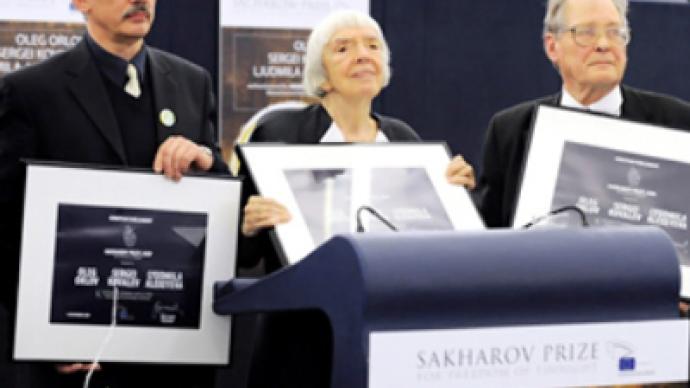
Oleg Orlov, Lyudmila Alekseyeva and Sergei Kovalev receive European Parliament’s 2009 Sakharov Prize in Strasbourg
TAGS: EU, Russia, Human rights
The Russian human rights defense organization Memorial and its three leaders have received the European Parliament’s 2009 Sakharov Prize for freedom of thought, named after the late physicist-turned-dissident.
Oleg Orlov, Sergei Kovalev and Lyudmila Alekseyeva received the prize in Strasbourg. Jerzy Buzek, the president of the EU Parliament, handed over the award and the prize money of 50,000 euros ($73,000).
Memorial, which was founded in 1988, campaigns for the protection of basic human rights in states such as Russia, Ukraine and countries in the South Caucasus. Refugees and victims of discrimination are among those it helps.
Recent years have taken a heavy toll on the organization. During the ceremony, one of Memorial’s founders, Sergei Kovalev, paid tribute to soldiers of conscience, “This prize is theirs by right. The first is Natalia Estemirova, human rights defender and fellow member of Memorial, shot in Chechnya. Among others I should also mention Stanislav Markelov, a lawyer; Anna Politkovskaya and Anastasia Baburova, journalists killed in Moscow; Nikolai Girenko, an ethnologist shot in St-Petersburg; Farid Babaev, killed in Dagestan, and many others. Sadly this list could go on.”
The prize was established in December 1988. The EU parliament’s political group leaders decided on this year’s winner. It coincided with the twentieth anniversary of Sakharov’s death. The first father of the Soviet hydrogen bomb, he became one of the Soviet regime’s most courageous critics.

16.12.2009, 15:06
10 comments
Russia – NATO talk Afghanistan, securityPresident Medvedev will entrust the government with looking into the NATO chief’s proposals on expanding Russia’s cooperation in Afghanistan, the Russian Foreign Minister said. Russia-NATO relations |
16.12.2009, 17:29
3 comments
Russian Federation Council gives president green light to deploy troops abroadA political analyst from the Institute of World Economy and International Relations, Aleksandr Pikaev, explained the Federation Council’s move to RT. |


What is a stain on this prize is its clearly political motivation. Memorial leadership has shown a stunning lack of prudence in the aftermath of Ms. Estemirova's death. Unfounded public accusations made me very much not trust their judgment. One cannot easily trust an organization that lashes out without a scentila of a proof at public figures accusing them of murder. There is an ongoing problem with the journalistic and human rights community. They thrown caution to the wind when they believe, rightly or wrongly, that they have a lead in a case. The problem is, chasing sensational story more often then not leads these overzealous and vulnerable people to criminal elements. Those elements have every interest in silencing them, especially as the eyes are going to be on the authorities. The lack of progress is directly linked to the criminal MO of underground. They can easily pay a small operatives to carry out murders, get rid of a mettlesome eager-beavers, and throw all the flak on the authorities. I am surprised that human rights activists do not get the law enforcement into their confidence early on, as their solo investigations are just too dangerous. The problem is, many of them think that authorities are the problem. They may have to learn that authorities can be their best friend when investigating murky people and their business.