Hague tribunal wakes up to Mladic interview
Published: 02 September, 2011, 08:29
Edited: 02 September, 2011, 11:51
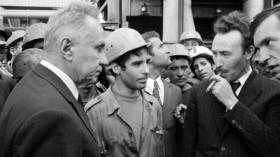
Commander of Serbian forces in Bosnia General Ratko Mladic (C) speaks to a Serbian soldier on February 15, 1994 (AFP Photo / Pascal Guyot)
(27.7Mb) embed videoTAGS: Conflict, Crime, EU, Politics, Europe, Human rights, Law, Anissa Naouai, Marina Dzhashi
An interview with wars crimes suspect Ratko Mladic carried by RT two weeks ago seems to have been news not only to the public, but also to the one international body which is supposed to be most aware Balkan war-related matters - The Hague Tribunal.
At least this is what RT judges from an inquiry about the interview and how it came into RT’s possession, ordered by a criminal investigator of the Tribunal.
RT will naturally co-operate with the investigation in the interests of justice, although the fact that such an important piece of evidence was missing from the Tribunal’s materials is somewhat surprising, especially since the interview dates back to 1995 and was done by a Western TV channel.
The interview with Mladic, a former general of the Yugoslav army and later the army of the Republika Srpska, was recorded shortly after the Srebrenica massacre, the mass killings of Bosnian Muslims which the Tribunal has defined as genocide. In it, Mladic voiced several serious allegations against the UN peacekeeping force.
“Instead of disarming the Muslim formations, as they had committed themselves to doing… the United Nations forces turned those safe areas into terrorist and fundamentalist bases from where our villages and towns were attacked,” he said
The ex-general also accused the UN of smuggling weapons into the supposedly demilitarized zone.
“Sometimes, they even used helicopters to airlift weapons from Iran and other combat hardware. We knocked down one such helicopter on the outskirts of Zepa two or three months ago,” he said.
Mladic, who was arrested in May 2011, is standing trial in The Hague for this episode and other alleged war crimes. He is the final prominent Serb leader to face this fate. The last Yugoslav President Slobodan Milosevic stood in the dock for five years before dying in the Tribunal’s custody, while the President of Republika Srpska Radovan Karadzic has been on trial in The Hague since his arrest in 2008.
The International Criminal Tribunal for former Yugoslavia (ICTY) was established in 1993, when the series of bloody armed conflicts in the Balkans was far from over. The UN Security Council formed the body to prosecute the gravest atrocities committed by all the warring parties.
Over the 18 years of its existence it has drawn a lot of criticism. It faced allegations of bias based on the fact that almost 70% of indictments it issued were against Serbs. Its fiercest critics called the Tribunal a political show rather than a court of law.
Some of ICTY’s sentences were seen as astoundingly mild, as was the case with Bosnian military commander Naser Oric, who was tried for raiding Serbian villages and torturing prisoners, and was sentenced to merely two years and then totally acquitted of all charges on appeal.
There is also criticism over the ICTY’s lack of will to investigate atrocities allegedly committed by non-Serbs. The most widely-publicized case is the allegation of trafficking of donor organs harvested from kidnapped Serbs during and shortly after the war in Kosovo. The suspected crimes had been investigated by the UN as early as 2004, but were not given due coverage until 2008, when former ICTY Chief Prosecutor Carla Del Ponte published a book on them.
More generally, some argue, the Tribunal’s activities have not served the interests of reconciliation in the Balkans. It is viewed with suspicion by Serbs and Croats alike, who doubt the ICTY’s integrity and call its decisions biased, although in cases where both parties are involved, the direction of the alleged bias would often be opposite depending whose side you talk to.

02.09.2011, 03:33
6 comments
NATO eyeing Libya’s riches?Deposed Libyan leader Muammar Gaddafi has accused foreign powers of eyeing Libya's oil and natural resources – and he has found at least one sympathetic ear in US presidential candidate Stewart Alexander. Arab world protests Libyan conflict |
02.09.2011, 09:59
8 comments
Root of Syrian unrest: Politics or religion?Britain, the US and France are pushing for harsher sanctions against Syria’s President al-Assad, who is believed to have ordered the torture and death of protesters. But on the streets there seems to be no real evidence of anti-government sentiment. Arab world protests |
Genocide Denial by Serbia.
http://en.wikipedia.org/wiki/Srebrenica_massacre
The Srebrenica genocide is very well documented and proven byond a reasonable doubt with DNA profiling for about 8000 missing persons.
Also it has been acknowlwedged by Serbian officials that VRS has ordered the killings.
No one denies that there have been casualties. But the numbers are overrated. The town/village Srebrenica had 6000 citizens (read: men, woman and childeren) before the war. Now the lawyer of Mladic asked the Tribunal to hand over the list of victims. I'm very curious if he will get it.
It was a war, so on the front people died. Not only Bosnian men, but also Arabic mercenaries (jihad-fighters) and there were also Serb casualties. The question is which part of the casulaties is Bosnian men who did not participate in the war. If think it is very clever of the lawyer to ask for the list.
In the Serb army there were men who lost their families by the hands of the muslim warriors during the outbreaks organized by Naser Oric and they took revenge on the Muslim fighters. That was bad, but every party during this war had blood on his hands. And Mladic should face triall because he is responsible for his men (if he could control them is another question: can one men control everybody?). But it is wrong that only a hand full of Muslims and Croats face triall in The Hague and the rest of them are living La Vida Loca in Bosnia and every higher ranked Serb is in The Hague. And the ones who face triall get much lower punishment then the Serbs. As long as The Hague doesn't triall also those Muslims and Croats (even) who have blood on their hands it will be a political court.
Every story has two sides!


Among 8373 unarmed people that were tied and executed and dumped in to the mass graves were 500 CHILDREN
On Serbian list of 293 Serbs killed around Srebrenica throughout the Bosnian war there are only 5 children (2 younger than 16). Most of the people from the list are people of military age killed in fighting as Hague tribunal in case of Naser Oric clearly presented. Serb forces had massacred and expelled Muslims across the whole of East Bosnia – at Bijeljina, Zvornik, Visegrad, Foca, Bratunac, Srebrenica itself and elsewhere; 94.83% of the civilians from the Podrinje (East Bosnia) region killed during the war were Muslims and ONLY 4.87% WERE SERBS more Muslims from Podrinje were killed in 1992 than in the year of the Srebrenica massacre. Three years before the 1995 Srebrenica massacre, Serbs destroyed 296 Bosniak villages and killed at least 3,166 Bosniaks around Srebrenica. The military actions of Oric’s Muslim forces against neighbouring Serb villages were those of defenders of a beleaguered enclave whose inhabitants were threatened with massacre, rape, torture and expulsion already inflicted on other towns all over East Bosnia.