VERSIONS: روسيا اليوم NOTICIAS FREEVIDEO ИНОТВ RTД
breakingnews
Go to main page   News   EU's Greek gamble: 50% bank debt write-off  
MORE ON THE STORY
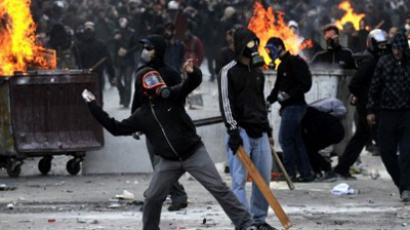
Masked demonstrators in Athens on October 20, 2011 (AFP Photo / Louisa Gouliamaki) 21.10.2011, 10:56 7 comments

Greece: cradle of austerity

Greece wakes up this morning to a new age of austerity. Parliament has passed a fresh package of pay cuts and tax hikes in attempt to stave off bankruptcy. The decision has been met with violent unrest in Athens.

Eurozone crisis
Greek Navy Frigate «Nikiforos Fokas» (Image from hellenicnavy.gr) 27.10.2011, 03:50

Hungry Greeks force-fed French Frigates

The German news magazine Spiegel has revealed a French plan to sell Greece up to four new warships – on credit. It is valued at around 300 million euros, even though Greece is struggling to meet its current massive debt obligations.

Eurozone crisis
Students shout slogans during a demonstration in central Athens on October 12, 2011 (AFP Photo / Angelos Tzortzinis) 26.10.2011, 10:12 5 comments

In da crisis: Greek hip hop against austerity

As talks continue to try to find a resolution to the euro zone crisis, RT has found a group of people who are cutting through the political rhetoric and telling it how it really is – Greek hip hop artists, “Soul System.”

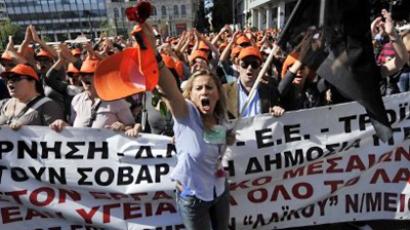
Health workers chant slogans by the Greek Parliament at Athens Syntagma square (AFP Photo / Louisa Gouliamaki) 20.10.2011, 11:59 10 comments

Greeks back austerity bill as police clash with protesters

The unpopular austerity bill has finally been passed following a vote in the Greek Parliament, while outside police were using tear-gas to disperse the thousands of demonstrators that had gathered around the parliamentary building in Athens.

Eurozone crisis
European leaders and EU members pose for a family picture prior to an European Council at the Justus Lipsius building, EU headquarters in Brussels on October 23, 2011 (AFP Photo / John Thys) 26.10.2011, 12:20 1 comment

EU "make-or-break talks" on the way

European leaders have dithered and delayed reaction to the evolving debt crisis, after spending 18 months discussing without decisive actions. Today, EU leaders will meet again in Brussels to finalize a new plan to recapitalize European banks.

Berlin : German Chancellor Angela Merkel (C) prepares to vote on plans to boost EU to fight the crisis at the Bundestag, the lower house of parliament, in Berlin. (AFP Photo / Odd Andersen) 26.10.2011, 21:57 4 comments

Germany approves boosting of EU’s bailout fund

Another EU leaders’ summit has kicked off in Brussels aimed at taking concrete steps to deal with the Eurozone debt crisis. Ahead of that, German legislators agreed to support a massive expansion of the European bailout fund.

Eurozone crisis

EU's Greek gamble: 50% bank debt write-off
Published: 27 October, 2011, 10:15
Edited: 27 October, 2011, 16:28

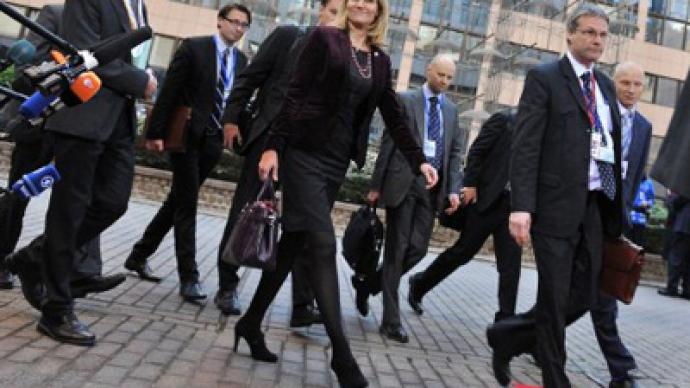
Danish Prime Minister Helle Thorning-Schmidt (C) arrives prior to an European Council at the Justus Lipsius building, EU headquarters in Brussels, on October 26, 2011 (AFP Photo / Georges Gobet)

Danish Prime Minister Helle Thorning-Schmidt (C) arrives prior to an European Council at the Justus Lipsius building, EU headquarters in Brussels, on October 26, 2011 (AFP Photo / Georges Gobet)

TRENDS: Eurozone crisis

TAGS: Meeting, EU, Crisis, Banking, Global economy


European banks agreed early on Thursday to write off 50 per cent of Greek debt. The deal was reached during an emergency summit in Brussels overnight. The EU and the IMF will also give the country another one hundred billion euros in rescue loans.

An agreement on expanding the bailout fund to one trillion euros followed immense pressure on EU leaders after multiple delays in anti-crisis action. Athens will be handed a new €100bn bailout package in early 2012.

“The Eurozone stands ready to provide additional program financing of up to €100 billion until 2014, including the required recapitalization of Greek banks,” the official communiqué reads.

As the write-off falls this time on the shoulders of private investors, the agreement guarantees them a €30 billion sweetener in exchange for the deal which will come partly from the European Financial Stability Facility (EFSF) and partly from money made by the Greek government on attempts to privatize its state assets.

“We have a voluntary agreement with the private sector, the parameters of which we have discussed with their representatives. As France has been asking from the beginning, we have excluded the possibility of a default of Greece. The private sector has written off half of the debt that it holds,” French President Nicolas Sarkozy told journalists after the summit.

Click to enlarge
Click to enlarge

The new debt reduction measures will bring Greece's debt down to 120% of gross domestic product by 2020, experts say. 

Greek banks are estimated to have the biggest capital holes on their balance sheets, Euroactiv.com wrote on Thursday. Figures from Morgan Stanley estimate that Greek banks would require over €80 billion in handouts, while Spain, Italy, France and Germany require up to €30 billion between them.

EU Commission President Jose Manuel Barroso in his turn described the agreement as “a very solid way forward,” adding that the EU’s fight against a default in Greece is more a marathon than a sprint, meaning the effect of the measures will only become apparent in a long-term perspective.

German Chancellor Angela Merkel expressed confidence that the measures agreed would solve the crisis.  

“I do believe that we were able to live up to expectations, that we did the right thing for the Eurozone, and this brings us one step further along the road towards a good and sensible solution,” Merkel stated after the deal was reached.

However, not everyone thinks showering Greece with fresh cash will remedy the crisis.

“The money we have spent on Greece is lost money. I have said this since spring 2010. We should have kept Greece out of the Eurozone”, Markus Kerber, a professor of political economy at the Berlin Institute of Technology, told RT.

­Greece to nationalize some banks

­The Greek government is going to put some banks in the country under state control as part of a move to  increase the capitalization of the Eurozone’s financial institutions, the Greek PM announced on Thursday.

“A number of banks will be partially nationalized. After the planned restructuring is done, we’ll open them back to the market,” George Papandreou was quoted as saying by Bloomberg news agency.

The banks in question were not named and no further details of the planned share exchange were given.

“After the deal is done, the situation with the Greek financial institutions will be clarified, and the banks will become viable and risk-protected,” Papandreou added.


+3 (5 votes)
 
Back to top
next MORE NEWS
Police arrest an Occupy Wall Street protester during a demonstration to show support for their counterparts in Oakland, California on October 26, 2011 in New York City (Spencer Platt / Getty Images / AFP) 27.10.2011, 07:27 8 comments

NYPD vs OWS: Crackdown but no backdown

New York police officers have been arresting Occupy Wall Street demonstrators who took to the streets Wednesday to decry a crackdown against fellow protesters in Oakland, California, RT correspondents reported.

Occupy Wall Street
Niki Roubani of the Bank of Voluntary Time project gives free art classes 27.10.2011, 10:51 2 comments

Cashless transactions: Greeks’ creative crisis solution

Whether the EU anti-crisis plan is effective or not, for the austerity-hit Greek people a creative solution could be the answer to some of their problems. In a country where cash is in short supply, time has taken on a whole different value.

Eurozone crisis
Nay Lin Maung October 28, 2011, 03:48
-1

Europe is really far behind. or Europe cannot catch with 21st century.


As a result, they are in the financial crisis today.


It is good time for Europe to reform.


Roberta Kelly October 27, 2011, 18:44
-1

The one world government plot is again exposed.

The criminal enterprising by the "leaders" of Europe and of course the USA and what country did not want to be in the game, in reality.

The problem was and is, as always, the play fair and the NOT play fair.

When the game gets real, the play fair discover the NOTS and then the game is over.

Greece found the European Union leadership from their country joined in contract with the EU leaders from NOT their country.

A contract was vitiated.  A NON-open contract for the people in a time when there is no excuse.

Continuance of these so called EU, USA, ET AL "leaders" to use computer keystrokes as money to enslave the entire human population globally.

In one word, NO.

EML (unregistered) October 27, 2011, 18:11
+1

IMF gives another 100 billion euros???  )))    Greece  in real is bad now!!!   be hold greek people,  your grandchildren shall be paying for your stupidness!!!