VERSIONS: روسيا اليوم NOTICIAS FREEVIDEO ИНОТВ RTД
breakingnews
Go to main page   News   Greece passes debt reduction bill amidst strikes  
MORE ON THE STORY
A protester holding a Greek flag shouts slogans during an anti-austerity rally in front of the parliament in Athens February 18, 2012 (Reuters / Yiorgos Karahalis) 22.02, 19:01 5 comments

Downgrades and demos: Greek malaise continues

Greece braces for fresh round of protests as a historical bailout package comes with austerity measures many refuse to stomach. Further rocking the boat, a downgrade on Greece’s sovereign debt has cast a dark cloud over already stormy waters.

Eurozone crisis
Steven Vanackere (L), Francois Baroin (2nd L), Lucas Papademos (C) and Evangelos Venizelos (R) attend a Eurogroup meeting at the European Union council headquarters in Brussels February 20, 2012 (Reuters / Yves Herman) 21.02, 08:02 10 comments

The path o’ non-resistance: Greece gets new lifeline

Eurozone finance ministers have reached a deal for a second 130-billion-euro bailout for crisis-stricken Greece. The country’s debt will also be lowered by private holders who agreed to face value loss of 53.5 per cent on their bonds.

Eurozone crisis
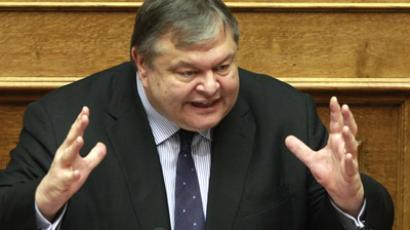
Greek Finance Minister Evangelos Venizelos. (Reuters / John Kolesidis) 16.02, 07:39 8 comments

Greek finance minister says EU bailout disputes solved

Greece has clarified all issues surrounding the country's austerity program for this year, Finance Minister Evangelos Venizelos says. But some sources claim EU finance chiefs still plan to delay a second bailout for the crisis-stricken country.

Eurozone crisis
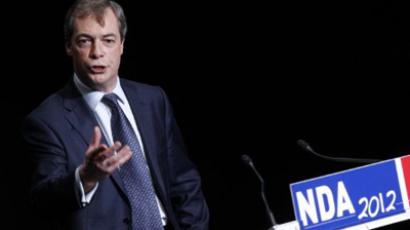
Nigel Farage (AFP Photo / Thomas Samson) 16.02, 01:05 4 comments

‘Greece bound to the euro to keep European project alive’

EU leaders are mulling a delay of the Greek bailout until the country votes in an April parliamentary election, Reuters reports. MEP Nigel Farage calls the option blackmail against Greece, which is being sacrificed to save the European integration.

Eurozone crisis

Greece passes debt reduction bill amidst strikes

Published: 23 February, 2012, 22:52
Edited: 24 February, 2012, 10:58

Health workers shout slogans during an anti-austerity rally in front of the parliament in Athens February 23, 2012 (Reuters / John Kolesidis)

(34.8Mb) embed video
TRENDS: Eurozone crisis

TAGS: EU, Crisis, Protest, Politics, Matt Trezza, Economy, Greece


The Greek parliament has approved a bill on an unprecedented debt write-down with private investors, a vital part of the EU’s bailout plan, which is set to save Athens over €100 billion.

­The bill, which was passed on Thursday, will pave the way for a massive bond swap whereby private investors are to exchange their bonds for new ones of lower value and longer maturity. The restructuring would wipe €107 billion ($142 billion) off the country’s privately-held debt.

Greece is now expected to issue a formal offer to bondholders. Officials say this must be done by Friday and completed by March 12, when the country will face debt repayments amounting to €14.5 billion.

Athens hopes to get at least two thirds of private creditors to sign up to the deal. This would allow the swap to be enforced on the remaining lenders. There are still concerns, however, that private investors will not be so eager to buy any new Greek debt. They already hold about €200 billion of Greek bonds and with the swap will take a real loss of 73-74 per cent.

The private debt restructuring is a key demand put forward by the EU to Greece in exchange for another bailout worth €130 billion ($172 billion) in loans to be paid by 2014. The eurozone finance ministers approved the package on Tuesday, thus averting Greece’s default on all obligations for March.

Analysts say that while allowing Athens to service the debt next month, the EU is setting Greece unachievable goals in terms of reducing its sovereign debt by 2020. The EU’s economy continues to shrink and the European Commission expects Greece’s economy to contract by 4.4 per cent in 2012.

This is a very tough call to reduce the debt from 160 per cent of GDP to 120. Even in the best case scenario it will hardly be lower than 130 per cent,” international lawyer Nick Skrekas told RT.

In return for the money, the EU is also demanding that Greece amends the constitution so that debt repayments take priority over the country’s other commitments. The EU’s obvious desire to guarantee that Athens honors its obligations after the parliamentary poll in April has one big obstacle in its way though. This is the Greek constitution itself, which can only be changed once in five years. As the Greek government promises to revise it, the next update may be scheduled for no earlier than May 2013.

The new relations with the EU and the prospects of more spending cuts have cast a shadow of gloom over the Greek people. While they continue to call for abandoning the eurozone, George Koo,  founder of International Strategic Alliances, believes that, on the contrary, the euro was never the cause of the country’s economical problems and abandoning it will never become a solution.

“When you live beyond your needs for as much as Greece has, [you] pay for the consequences,” he told RT. “You can print your own money, the drachma in their case. It may help them to prolong the agony and allow to continue to live beyond their means, printing more and more currency, but eventually you pay a price. Greek currency will have less and less value on the world market. People are just going to avoid it. Adopting [the] euro is not the source of blame.”

However, they see nothing ahead but new rounds of austerity measures for years to come. More strikes hit the country on Thursday, when doctors and health workers expressed their anger at the government and international creditors in a 24-hour strike.

We can see the future of the EU in what’s happening in Greece today,

” says Professor Costas Douzinas of the University of London. “

You can push people out of the way until they leave the country if they can or they live off the rubbish bins. At the moment we have 22 per cent unemployment, 50 per cent unemployment among the youth, and a huge increase in homelessness, which may result in a proportional increase in suicide.


Watch RT's full interview with Professor Costas Douzinas


embed video

+7 (7 votes)
 
Back to top
next MORE NEWS
An undated portrait of German-born Swiss-US physicist Albert Einstein (1879-1955), author of theory of relativity, awarded the Nobel Prize for Physics in 1921 (AFP Photo) 23.02, 22:13 14 comments

Was Einstein right after all?

The CERN laboratory in Switzerland has found a flaw in an experiment that was set to prove Albert Einstein's social theory of relativity wrong. It will be carried out again in May 2012.

A wounded protester lies on the ground as Afghan policemen keep watch during a protest in Kabul February 23, 2012 (Reuters / Omar Sobhani) 23.02, 23:00 65 comments

Koran burning: Taliban calls for revenge as Obama apologizes

The Taliban is urging Afghans to attack Western military bases in revenge for the recent burning of copies of the Koran. President Barack Obama has officially apologized for the incident as more people die in anti-American violence.

Christian (unregistered) February 24, 2012, 13:17
+6

"A little bit dubious!?" Its a blatant violation of Greece and its hard pressed people nothing else, these eurofiles make me sick they have no care for ordinary peoples suffering only interested in making sure the banks get their money or rather the Greek people’s money.

The Micex February 24, 2012, 07:17
-1

and the Rubble is a Jewish gangster Cabal.  Russia thinks they are smart but there Kremlin speaks volumes on their Gangsterness of what is trying to be done to the EU.  Dumb Thug Russians

David762 February 24, 2012, 05:22
+8

Dimitri (unregistered) wrote in #2

I am Greek-American, born and raised in America, and in my retirement, living in Greece.  When you consider the frightening extent to which Brussels has degenerated, I don't know what more I can say.

First they came for the Serbs, but I wasn't Serbian.  Then they came for the Libyans, but I wasn't Libyan.  Then they came for the Iranians, but I wasn't Iranian.  Then they came for the Syrians, but I wasn't Syrian.  Then they came for us.

I can almost literally feel the pain suffered by the Greek people, now with their collective throats firmly under the jack-boot of the Rothschild international bankster cabal.  If it makes you feel any better (suffering loves company?), we will all soon be under that same jack-boot.  The Argentinean or Icelandic solution would, I believe, have been a less painful process  --  to let these bankster / gambler / kleptocrats eat their own financial losses, instead of passing it along to the taxpayers to bail out.  Here in the USA, the private for-profit central bank (The Federal Reserve), also owned by the Rothschild cabal, has plundered the USA Treasury to at least 95% of the CDO insured face value.  'Private profits and socialized risk' wasn't always the bail-out plan for these "investment" banksters  -- they used to self-insure before the banksters found a government teat to drain.  ------------  Pretty soon, we will all be Greeks ...