VERSIONS: روسيا اليوم NOTICIAS FREEVIDEO ИНОТВ RTД
breakingnews
Go to main page   News   Radioactive water being removed from Fukushima plant  
MORE ON THE STORY
Japanese Buddhist devotees offer prayers during a Buddhist ritual to invoke blessings on the earthquake and tsunami's victims in Japan at the official Presidential Residence in Colombo on March 27, 2011 28.03.2011, 07:17

Japanese pay last respects to earthquake victims

The destructive 9.0 magnitude earthquake and ensuing tsunami which struck the country three weeks ago and ravaged whole regions is now estimated to have killed over 11,000.

Earthquake in Japan
A protestor wears a gas mask to protest against nuclear plants (AFP Photo / Yoshikazu Tsuno) 27.03.2011, 20:06 6 comments

Japan's nuclear protest

Around 1,200 protesters took to the head office of the Tokyo Electric Power Co. in Japan’s capital on Sunday voicing their demands to close the atomic power plants in the country.

Fukushima nuclear disaster
"Fallout: New Vegas" game screenshot (http://fallout.wikia.com) 27.03.2011, 13:23

Playing it safe in Las Vegas

Minor amounts of the radioactive isotopes iodine-131 and xenon-133 are reported to have reached Las Vegas, but so far the readings are far below levels that could pose any health risks.

Earthquake in Japan Fukushima nuclear disaster
The level of radiation in the water of the turbine room in Unit 2 of the Fukushima 1 nuclear power plant now exceeds the admissible maximum by 10 million times 27.03.2011, 11:28 6 comments

Radiation in the water inside Fukushima reactor hits record level

Plant operator Tokyo Electric Power Co. now says the level of radioactive contamination in the leaked water from the No. 2 reactor was 100,000 (100 thousand) times higher than normal in the reactor's cooling system.

Earthquake in Japan Fukushima nuclear disaster
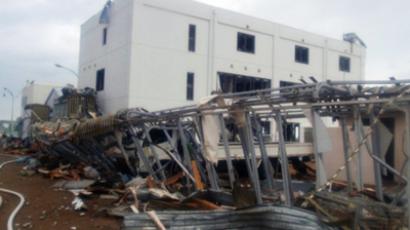
Destroyed building of TEPCO's Fukushima Daiichi (No. 1) atomic power plant (AFP Photo / HO / Nuclear and industrial safety agency VIA JIJI Press) 26.03.2011, 11:45 2 comments

Difficult to predict end of Fukushima crisis – Japanese spokesman

Japan’s continuing efforts to cool reactors at the Fukushima number 1 nuclear plant are being repeatedly impeded by the wavering radiation levels. However, work that was suspended due to high radiation levels earlier on Saturday has been resumed.

Earthquake in Japan Fukushima nuclear disaster
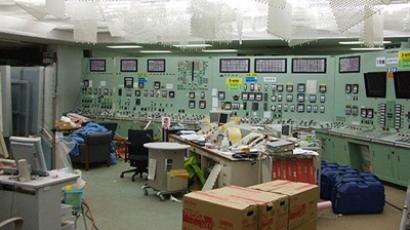
JAPAN, OKUMA : This handout picture, released by Tokyo Electric Power Co (TEPCO) on March 24, 2011 shows the central control room of the first reactor of TEPCO's Fukushima Daiichi (No. 1) atomic power plant at Okuma town in Fukushima prefecture (AFP Photo) 25.03.2011, 11:28

Japanese authorities expand evacuation zone, cite no health risks

The Japanese government is debating whether to expand the evacuation zone around the Fukushima power plant, where water radiation is now 10,000 times higher than the norm. The evacuation area is currently 20 kilometers around the plant.

Earthquake in Japan Fukushima nuclear disaster

Radioactive water being removed from Fukushima plant

Published: 28 March, 2011, 15:51
Edited: 28 March, 2011, 19:48

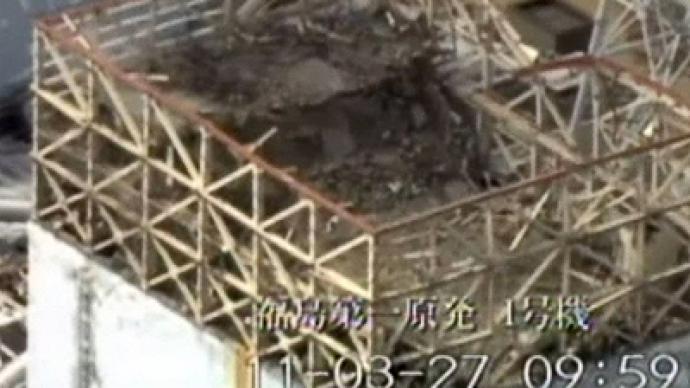
This image from video taken by Japan's Ground Self-Defense Forces on March 27, 2011 shows the exterior of reactor no. 1 building of the Tokyo Electric Power Co (TEPCO) Fukushima No.1 (Dai-Ichi) nuclear power plant in the town of Okuma, in Futaba district in Fukushima prefecture (AFP Photo / HO / Japan's Ground Self-Defence) FORCES

This image from video taken by Japan's Ground Self-Defense Forces on March 27, 2011 shows the exterior of reactor no. 1 building of the Tokyo Electric Power Co (TEPCO) Fukushima No.1 (Dai-Ichi) nuclear power plant in the town of Okuma, in Futaba district in Fukushima prefecture (AFP Photo / HO / Japan's Ground Self-Defence) FORCES

TAGS: Natural disasters, Nuclear, Accident, Japan


Plutonium has been detected in the soil at the Fukushima nuclear plant, Kyodo news agency reports, while radioactive water is being removed from inside the buildings in order to allow engineers to repair the plant’s cooling system.

The Agency quotes Tokyo Electric Power Co as saying plutonium has been detected in the soil at five locations at the crippled Fukushima Daiichi nuclear power plant. The operator of the nuclear complex said that the plutonium is believed to have been discharged from nuclear fuel at the plant, which was damaged by the March 11 earthquake and tsunami.

Kyodo News later reported it is not known which reactor the plutonium came from, but monitoring will be increased after it was detected at the Fukushima plant.

The Agency also quotes the Tokyo Electric Power Co. as saying high levels of radiation exceeding 1,000 millisieverts per hour were found in the water in a trench outside the No. 2 reactor's turbine building at the nuclear power plant in Fukushima. Similarly high levels of radioactivity have been found in a pool of water in the basement of the turbine building at the Fukushima Daiichi complex, raising concerns that radioactive substances may have seeped into the environment, including the sea nearby.

Tokyo Electric Power – the company operating the plant – appealed to the French government on Monday for help in controlling the complex.

The radioactive water found at the No. 2 reactor is believed to have leaked into the basement after having “contact with fuel rods (in the reactor's core) that have partially melted,'' Japanese official spokesperson Yukio Edano said Monday.

He also added that a continuation of the meltdown is not likely.
Edano said the government will put all its efforts into preventing the contaminated water from getting into seawater or seeping below ground.

The plant operator Tokyo Electric Power Co. corrected its earlier report, saying the level of radiation in the water at the No. 2 reactor was 100,000 times higher than usual as opposed to an earlier number of 10 million. 

Japan’s public broadcaster NHK reported on Monday that many residents decided to return to their homes in the area adjacent to the Fukushima plant. Those living within 20-30 kilometers of the nuclear plant were first asked not to leave in order not to get a possible high dose of radiation. Later, Japan's government asked people in the zone to leave voluntarily due to poor supply of the area.

Meanwhile, high levels of radiation were again detected in the sea water.  The Japanese nuclear agency claims, however, that there is no sign of radioactive water from the plant getting into sea, and says it is working on trying to prevent that from happening.

Russia’s Ministry of Foreign Affairs is still recommending that Russian nationals not visit Japan due to the worsening conditions at the Fukushima-1 nuclear power plant. .“We are still advising Russian nationals to refrain from trips to Japan as tourists or with any other private purposes, and those Russians already in the country to refrain from visiting the affected areas due to the very difficult situation there” says the official website of the Ministry.


+2 (2 votes)
 
Back to top
next MORE NEWS
Libyan rebels survey fighting along the front line during shelling with forces loyal to Libyan leader Moamer Khadafi at a location close to the town of Bin Jawad, which was seized yesterday by rebel forces, on March 28, 2011 (AFP Photo / Aris Messinis) 28.03.2011, 14:17 9 comments

Fighting moves to Libya’s center, NATO accused of taking sides

Armed conflict between Gaddafi’s troops and Libyan rebels has moved away from the sea coast into the central part of the country. Meanwhile, Russia has said NATO’s actions contradict the UN resolution and called them interference in a civil war.

Arab world protests Libyan conflict
Ingushetia, terror attack  (RIA Novosti / STF) 28.03.2011, 21:17 2 comments

Two detained in Ingushetia in connection with Domodedovo bombing

Two suspects, thought to be behind the terror attack on Moscow's Domodedovo airport, have been detained in Russia's southern republic of Ingushetia.

Global terrorism
kool March 28, 2011, 23:14
0

and where is it going???!!!