VERSIONS: روسيا اليوم NOTICIAS FREEVIDEO ИНОТВ RTД
breakingnews
Go to main page   News   ‘Eurozone is exploding!’  
MORE ON THE STORY
A woman holds a placard reading "Stop evictions" while a demonstration takes place in front of her building organised by the association "Affected by mortgages" (Afectados por la hipoteca) to stop the eviction of a family who can't pay their home mortgage payments in Madrid, on July 6, 2011 (AFP Photo / Dominique Faget) 06.09.2011, 10:56 2 comments

Outraged Spaniards fight for roofs over heads

Spanish authorities are gearing towards setting a constitutional cap on budget deficits. With unions expecting the move to further hit social welfare in the country, some people are taking to the streets to fight for their basic right: housing.

Eurozone crisis
AFP Photo / Pierre-Philippe Marcou 25.07.2011, 01:23 2 comments

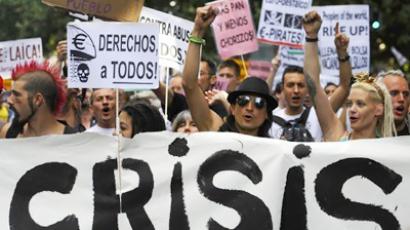
"Spanish revolution" in full swing

Thousands of protesters are gathering in cities across Spain daily to show their discontent with the current economic situation. They claim the government has failed to tackle the recession and high unemployment rates in the eurozone.

Eurozone crisis
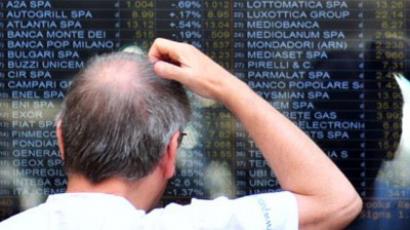
A man looking at a board outside Milan's stock exchange on July 11, 2011 (AFP Photo / Giuseppe Cacace) 14.07.2011, 19:12 2 comments

Austerity budget gets green light from Italian Senate

Italy is the latest focal point in the ongoing saga of the Eurozone debt crisis. Now, the Senate, the upper house of the Italian parliament, has approved an austerity package intended to save the country some 47 billion euros over three years.

Greek Finance Minister Evangelos Venizelos 01.09.2011, 18:50

Greek FM slams damning budget report

The Greek finance minister has criticized a report on the economy which said Greece was likely to miss its budget targets this year due to months of delays in implementing austerity measures and a deeper than expected recession.

Eurozone crisis
Members of the European Parliament vote during a session at the European Parliament in Strasbourg, eastern France (AFP Photo / Frederick Florin) 29.08.2011, 18:15 4 comments

Eurozone officials grilled over union’s debt crisis

The President of the European Central Bank has defended Europe's bailout-driven survival efforts, amid widening divisions on managing the debt crisis. A special economic summit in Brussels has focused on halting its spread in the EU.

Eurozone crisis
German Chancellor Angela Merkel greets French President Nicolas Sarkozy on July 20, 2011 in the courtyard of the Chancellory in Berlin (AFP Photo / Odd Andersen) 16.08.2011, 14:40 10 comments

Merkel and Sarkozy propose euro-zone “government” to tackle debt crisis

Germany and France are calling on all euro-zone members to enshrine a balanced budget in their constitution, as well proposing a collective “government” led by the EU president.

Eurozone crisis

‘Eurozone is exploding!’

Published: 06 September, 2011, 19:21
Edited: 06 September, 2011, 23:09

Riot policemen spray tear gas as they clash with demonstrators in front of the Greek parliament on June 29, 2011 during a protest part of the 48-hour general strike against the bankruptcy-threatened government which is desperately trying to push through sweeping austerity cuts (AFP Photo / Angelos Tzortzinis)

(40.7Mb) embed video
TRENDS: Eurozone crisis

TAGS: Crisis, Protest, Politics, Currencies, Budget, Tesa Arcilla, Government Spending, Economy


Protests have spread across Europe as Greece, Italy and Spain are struggling to hold on to the euro. Meanwhile, residents of the strongest European economies, such as France, believe that their countries would be better off with a national currency.

A million to march against the harsh new austerity package, vows Italy's biggest trade union. Italy is teetering on the brink of collapse over its massive debts.

The troubles of one of Europe's biggest economies threaten to destabilize the eurozone and spur a new financial crisis.

The removal of several controversial provisions, such as a temporary tax on the wealthy, sent markets into a spin, and sparked rumors of an imminent credit-rating downgrade.

Meanwhile across the Ionian Sea, efforts to rescue the Greek economy took a hit after Athens admitted it will not be able to meet deficit reduction deadlines.

Struggling economies will have to leave the eurozone, an ex-member of France's ruling party, Nicolas Dupont-Aignan, told RT. There are consequences for a currency system that cannot work.

Nicolas Dupont-Aignan, says that some countries, like Greece, will have to leave the eurozone, because they simply cannot keep up with economically stable countries.

“Greece cannot support the currency of Germany, it is not the same economy,” he declared. “Greece will be forced to leave [the] euro because the only means for Greece’s economy to recover is to devaluate.”

Dupont-Aignan says that the euro is too expensive for Greece: “You cannot have the same currency for Greece, with productivity which is not high, and for Germany.”

Even though France is not in the same situation as Greece or Italy, there is a high unemployment rate, and the French are becoming more and more dissatisfied with the current situation. Some believe that France should abandon the eurozone and revert to its own currency – the Franc.

“Government is saying to French people, ‘We will impose new taxes, but in the same day we are going to give to Greece 15 billion euros.’ We ask for the money from the French people to give it to Greece and it’s not working. So the French government is very unpopular,” says Dupont-Aignan.

Nevertheless, President Sarkozy's government is insistent that France's future lies with the euro. Nicolas Dupont-Aignan argues that this is a bad decision.

“We created Europe without the euro and it worked. It worked because when we had a problem we could devaluate and Germany re-evaluate its currency [after WWII.]. But now we cannot use money to ‘re-arm,’” he says. “People in Europe began just to understand that [the] euro is not working. You cannot have the same currency for countries [that] are completely different on the economic scale.”

“We are in a historic moment – [the] eurozone is exploding,” concluded Dupont-Aignan.

German economic analyst Michael Mross, believes it is those very deadlines and cuts that will be the euro's undoing

“Austerity means cuts. That means that you have cut the income of the poorest, that the social welfare will be cut down. What we see here is that politicians are promising many things and this is the problem that we really have,” he said. “People in Brussels also feel the pressure of the street will be so big that they cannot fulfil their promises. That means that in the end of the day the whole experiment of the euro will go down with the insolvency of Germany.”


embed video

+6 (10 votes)
 
Back to top
next MORE NEWS
Russia’s President Dmitry Medvedev talking to Queen Margrethe II of Denmark at the welcoming ceremony in the Kremlin (Image by RIA Novosti / Sergey Guneev) 06.09.2011, 18:44 2 comments

Danish royals grace Kremlin

Queen Margrethe II of Denmark, along with her royal husband and son, has stepped on to Russian soil 36 years after her first ever visit to the country. President Dmitry Medvedev has welcomed the esteemed guests in the Kremlin.

Protestors march on September 6, 2011 during a demonstration organized by the leftist General Confederation of Italian Workers (CGIL) union against the government's economic policy in the center Rome (AFP Photo / Andreas Solaro) 06.09.2011, 21:15 2 comments

Italians fired up at tax hike up

Tens of thousands of people are stranded. Factories are closed, airports and train stations deserted. An entire nation comes to a standstill as Italy's largest trade union, the CGIL, calls on its 6 million members to strike.

Eurozone crisis
Count Cash September 07, 2011, 20:05
0

Being in the Eurozone in a proper sense, means your economy matches the strength of the currency. Indeed the parameters of the Eurozone control, should instead be turned into tests, to determine whether a country has to exit the Eurozone. This will then preserve the correct level of the Euro against the underlying strength of the economies. Recently, there has been a game played, where Germany has been happy with some level of Eurozone crisis, to soften the Euro and thus increase its exports. It has exploited a softened Euro as a tool for growth. However, Germany doesn’t want a collapsed Euro, indeed Germany wants to set the Euro rate just right for itself, and this is understandable. They want the rate to match their economic strength and stimulate growth for them. They therefore, like China demonstrate that firstly there is a rate that is the correct rate for your economy and secondly a rate that is the correct amount lower, can stimulate growth. If a weaker economy is bound to the stronger economy in currency, then what happens is they provide a help for the strong economies and a detractor for their own. Yes they can wait until, they can strengthen their economies over time, so restoring the equilibrium; the problem is that that the process takes time, and that time means more escalating credit or sell offs to plug the efficiency and sustainability deficit in the weaker economy. So there is a simple race, can the economy recover fast enough, to fix itself, with additional monetary inflows added, or will the process take too long resulting in the additional weight of any credit creating an irrecoverable situation and default anyway. So the simple question to ask for the weaker one is – When will your economy be as strong as Germany? If the time/credit clock is against you, then you need devalue to set your currency to match your economy, plus add margin to stimulate growth.

Norman Hill September 07, 2011, 02:11
0

More financially established nations (Germany, France, Italy and Austria- even Poland) do not need pay the debts of weaker nations (Spain, Greece and Portugal)! It's interesting that the weaker nations (as listed above) were once great empires. Look at them today! Britain was smart enough to reject the EURO, though they are having problems now.

Phil (unregistered) September 07, 2011, 00:40
0

Perhaps those in Europe who have always looked upon the British as the awkward mob, always complaining about the EU, about its undemocratic laws, its embezzling of public money and its members who were not voted into their positions by the people of Europe, will now realise why the british people are so reticent. For centuries Europe has been a source of wars, internal problems and dictators and the British have always come to the aid of those in mainland Europe. We were always aginst one currency for 27 countries, it was a ridiculous idea 50 years ago and now its being proved to be a source of extreme irritation to many members of the EU. It needs to die, we can still trade with each country as britain has done for many centuries