‘EU lacks sense of society to politically unite’
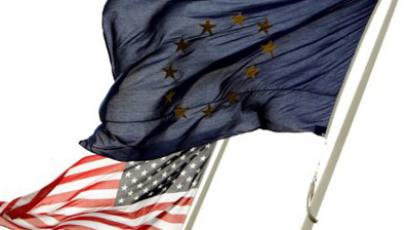
“A monetary union without political union is impossible to maintain,” economist Arjo Klamer said 20 years ago. And as Europe struggles to deal with the euro crisis, the EU countries are still too different to politically unite, Klamer told RT.
Klamer, who is a professor of the Economics of Art and Culture at Erasmus University in Rotterdam, says a political union should be formed now, because stronger fiscal coordination and better social policy would support the euro. However, “There is too much heterogeneity. The countries are too different. Countries are too attached to their own sovereignty,” he told RT.Klamer says European countries have a hard time working together on international issues. “At the moment it is inconceivable that Britain will give up their rights and also France is not even thinking of giving that up. Germany will be too powerful. There’s simply too much that prevents Europe from becoming a political union.”However, if you asked German Chancellor Angela Merkel, she would say that a “political union” is already taking shape. According to Klamer, Merkel is basing this statement on plans and suggestions. “These are suggestions or plans, to have stricter rules. And to enforce those rules, in her view, in her reality, that is moving towards a political union,” he said. “But my critique is, what is lacking, and what is really needed for a political union is also a sense of society.”Some call for a significant transfer of spending and taxing powers to a central EU government and parliament a “democratic sacrifice.”“It is an idea that I think in the end will backfire,” argues Klamer. “If you centralized this power too much, then what we will see is a lack of dynamics, a lack of flexibility as we see right now because it takes forever to make these decisions. It takes forever to get it through all these different parliaments. And then it takes even longer to implement it.”Meanwhile, a Greek government spokesman has said that “Greece faces an exit from the euro bloc unless it clinches a deal on a second 130-billion-euro bailout from its international lenders.” “They use it now as an argument to enforce all kinds of cutbacks and to get popular consent which they need in order to make the policy effective,” says Klamer. “I think that in Greece there is still an overall desire to hold on to the euro because the Greeks are very suspicious of their governments. So they desperately want to have ‘European government’ involved in their country because that’s sort of a countervailing power against their own politicians.”However, whether that rhetoric will bring results is another issue altogether. “I think the left, right and center are preparing for the fallout of Greece, that the Greeks are forced to step out of the euro, because this is unsustainable.”According to Klamer, the best strategy for Greece would be to devalue their own currency, to make their country much cheaper, and use that as the beginning of a new effort to organize commercial activity in conditions which would enable them to sell and export.The alternative strategy is painful, argues Klamer. It is “lowering salaries and wages and cutting back and that causes a huge depression in that economy.” The main cheerleaders of the euro are Merkel and Sarkozy, with French and German elections coming up in 2012 and 2013 respectively. Klamer says holding on to the euro with everyone making sacrifices, forsaking national interests in the name of European ones is “a message that’s very hard to sell in election time.“But that is also again an illustration of a lack of political union. A lack of society that will become an issue and that the fate of the European Union is dependent upon national elections,” he said. “You cannot imagine the fate of any country is dependent upon the outcome of local elections. That’s unheard of. And that illustrates once again that the union in Europe is not that strong. It’s forced. It exists among the European establishments.” “So if you walk around Brussels, you feel like the European Union is for real. But as soon as you’re away from Brussels and walk around in the country in the rest of Europe, then you see that Brussels is far away from that and not really the reality that people live with.”Experts and analysts, even if they consider themselves Eurosceptics, are already saying that sticking with the euro and being “forced” into closer European integration is probably the better option because the alternative is a financial crisis. However, Klamer supports the idea of leaving the euro behind, even if this brings about a crisis.“Focus less on economic growth. Focus more on sustainability. But especially focus on quality – quality of food, quality of living conditions, being concerned about local resources. And strong regions. Strong societies. Strong cultures. That is what we are interested in,” he said.