VERSIONS: روسيا اليوم NOTICIAS FREEVIDEO ИНОТВ RTД
breakingnews
Go to main page   News   Earth not alone: Two more sibling planets orbit Sun-like star  
MORE ON THE STORY
Image from sciencedaily.com 11.01.2011, 10:44 2 comments

Space observatory finds smallest exoplanet

NASA’s orbital telescope Kepler has found the smallest-ever planet outside of the Solar System.

Planet Earth viewed from space 06.12.2011, 21:04 25 comments

Earth's sibling located...600 light-years away

The search for Earth-like planets has finally borne fruit. Or at least that is what NASA claims, raising hopes among inhabitants of an exhausted Earth of a back-up planet for humanity.

Fobos (RIA Novosti) 14.11.2011, 22:45

Russia still hopeful about Red Planet dream

Russia's Space Agency has not given up hope of completing its mission to Mars.

Russia has launched the country's first interplanetary mission in 15 years (image from http://www.federalspace.ru) 10.11.2011, 20:42 17 comments

Martian curse: Russian probe may crash in populated area

Russian scientists are struggling to get the country's first interplanetary mission in 15 years back on track. Should they fail, the probe that was due to head to the Martian moon Phobos may well turn into the “most toxic falling satellite ever.”

The Phobos-Grunt lander is designed to land on the Martian moon Phobos, return soil samples to Earth, study its physicochemical characteristics, collect data on the origin of Mars moons, Mars atmosphere and the interaction between small bodies of the Solar System and solar winds. (RIA Novosti/ Aleksey Filippov) 22.09.2011, 18:48 7 comments

Back to Mars: Russian probe to visit red planet

Constructors of the Fobos-Grunt probe have revealed details of the space mission to Mars, which is to break a 20-year absence of Russian spacecraft near the red planet. The mission involves the retrieval of a soil sample from one of Mars’ satellites.

Earth not alone: Two more sibling planets orbit Sun-like star
Published: 21 December, 2011, 17:25
Edited: 22 December, 2011, 09:27

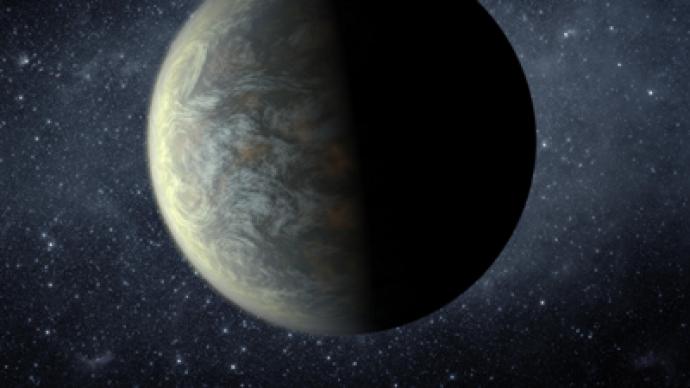
Artist's Concept of Kepler-20f (image from http://www.nasa.gov)

Artist's Concept of Kepler-20f (image from http://www.nasa.gov)

TAGS: Space, SciTech


Hot on the heels of the Kepler space telescope’s discovery of the “Earth sibling” Kepler-22b, NASA has announced the discovery of two more planets which appear to be Earth’s close relations – in size, at any rate.

The agency says Kepler-20e and Kepler-20f are the smallest exoplanets orbiting a star that have been found to date. The term “exoplanet” refers to planets outside our Solar system, and every finding of this kind is of great scientific and potentially practical importance, as it increases the chances of finding life-supporting worlds like our own.

The scientists behind the discovery believe that both planets are rocky, with a composition of iron and silicate, and may have a thick water-vapor atmosphere. However, despite being very similar to Earth in size – 1.03 and 0.87 the radius for Kepler-20f and Kepler-20e, respectively – they are far too hot to be even potentially habitable. The temperature on the surface of Kepler-20f is an impressive 426ºC, while Kepler-20e is even hotter – 426ºC.

The reason for the high temperatures on these planets is that their orbits pass very close to Kepler-20 – their star, which is very similar to the Sun. For the same reason, their orbits are also far shorter, with a “year” on Kepler-20f lasting 19.6 days, and Kepler-20e zipping around its star in just 6.1 days.

Earth-class Planets Line Up (image from http://www.nasa.gov)

Earlier this month, NASA announced the first-ever discovery of an exoplanet orbiting its star in a warm, habitable zone where liquid water could potentially exist on the surface. However, Kepler-22b – the name given to the planet – is 2.4 times bigger than Earth. Its year is about 290 days long, and because its star, Kepler-22, gives about 25 per cent less light than our Sun, scientists suggest that the planet’s temperature may be a comfortable 22ºC. But the nature of the surface of Kepler-22b is unknown. It may prove to be rocky or gaseous, as well as liquid.

However, none of these planets can be considered our close neighbors, and the stars they orbit are beyond the reach of any spacecraft likely to be created in the foreseeable future. It would take 600 light years to reach Kepler-22 from Earth, and Kepler-20 is as far as 945 light years away.

Nevertheless, it is difficult to overestimate the importance of these latest findings.

It is the first time humanity has been able to discover an object similar to the Earth orbiting around a star, so maybe we will be able to find others,” MailOnline quoted Dr. Francois Fressin, one of the astronomers from the Harvard-Smithsonian Center for Astrophysics in the US, as saying. “This could be an important milestone.

Kepler-22b – Comfortably Circling within the Habitable Zone (image from http://www.nasa.gov)
+9 (9 votes)
 
Back to top
next MORE NEWS
The Soyuz TMA-03M rocket of the ISS in Baikonur cosmodrome 21.12.2011, 17:20 1 comment

Russia’s Soyuz rocket takes three spacemen to ISS

A Russian Soyuz rocket has been successfully launched from Baikonur cosmodrome in Kazakhstan. The rocket, carrying an international crew of three, has reached its designated orbit as it makes its way to the International Space Station.

FEMEN activists Inna Shevchenko (center) and Oksana Shachko (right) and Aleksandra Nemchinova (left) speaking to journalists in the town of Yelsk in the Gomel region (RIA Novosti / Egor Eryomov) 21.12.2011, 18:25 8 comments

First FEMEN images after alleged KGB torture

Ukraine’s topless FEMEN protesters have arrived home safely after allegedly being kidnapped by the Belarusian KGB, taken to the woods, stripped and left alone with no clothes or money. The KGB denies the accusations.

lewis December 22, 2011, 10:52
+1

Soon as the inhabitants of this planet start looking at themselves for the solving of their problems and not relying on the govt for the solving of their problems this will be a better planet to live on..in other words everyone must take 100% responsibility for their thoughts and actions, soon as they do this they will work out they dont need a govering body eg govt or religion to rule them or the royals all are a joke....as for nasa and their antiquated space rockets lol its very amusing to watch them spend trillions of us tax money on outdated projects while they excell in other areas of technology unseen or understood by the public.....amusing to say the least...

Sphere Of Inlfuence December 22, 2011, 05:19
-1

Space exploration is overated. We can barely take care of ourselves on earth and we have the unmitigated gall to spend Billions on "travel". Once we learn how to love and live with each other, it would then make sense to seek alien life.

Allah please end the Empires of December 22, 2011, 05:02
-1

Europe

China

Russia

Usa

Latin America

and

Australia


and only see our way