The year of dissent: Russia between change and chaos
2011 was marked by the largest political protest in Russia in two decades. Some see it as the Arab Spring going north, others a sign of the middle class taking its due place. Still others as a bid for West-sponsored regime change...Or a bit of each.
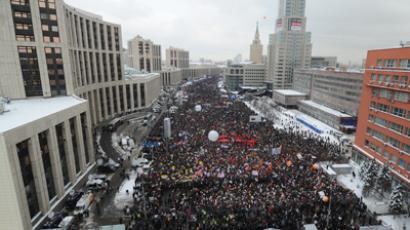
The outgoing year was marked by protest against the establishment unfolding all around the world. In several Arab countries it resulted in the fall of decades-old governments – more-or-less peacefully in Tunisia, half-heartedly in Egypt, disastrously in Libya. In the US and Europe the Occupy movement has been raising its voice for social justice, and it is increasingly hard to ignore. It appears humanity, strained by the global economic crisis, chose the time to resolve the conflicts that had been muted down in the years of prosperity.Russia did not go against the global trend. A long-unseen protest movement has arisen since the parliamentary election on December 4. Even as the ballots were being counted, the Russian segment of the internet became abuzz with reports and videos of alleged cases fraud. Several unsanctioned rallies took place and were promptly dissolved by the police. Less than a week later, Moscow saw the biggest protest rally in two decades, while dozens of Russian cities held smaller-scale events. Two weeks after that, the record was broken again, with police estimating the number of demonstrators at between 70 and 80,000.The authorities’ reaction to the surge of dissent was quickly sliding. Initially, top officials celebrated the victory of the United Russia party, despite that fact that it lost plenty of seats in the parliament, while the election commission was praised for doing a good job. After the Bolotnaya Square rally on December 10, some officials – including Prime Minister Putin – ridiculed protesters, implying that they are either being manipulated into starting a riot, or are on the payroll of Russia’s rivals. At the same time President Medvedev announced a large political reform, which would liberalize the system. After the second demo on December 24, an unexpected reshuffle among top officials happened, which had Vladislav Surkov, the man called “Kremlin’s grey cardinal” by the opposition, moving out of his position.The demonstrators’ biggest problem is that their driving emotion is dissatisfaction with the current system, and when it comes to what they want to see instead of it, they mostly disagree. They want it to be fairer, less prone to corruption and more flexible, but there is no leader with a plan for how to implement it. At the same time many see the government’s initiatives as outdated and want nothing short of the election results being scrapped and Vladimir Putin stepping down from his run for a third presidential term.March 2012, when the presidential election is to take place, is likely to become the deciding moment for Russia’s future. Coming up with a candidate who will have strong support outside of the online, politically-active community, which is the backbone of the new opposition movement, on such a short notice is a hard task indeed. Critics say opposition leaders like Aleksey Navalny will brand the future ballot as rigged regardless of whether it is or not. Their only goal is to change the regime and get into power, whatever the price, is the concern.Nevertheless so far the Russian “Snow Revolution”, as some media have dubbed it, has been exemplary in behaviour: civilized and peaceful. Protesters certainly made their message clear though. It is up to authorities to stand up to the challenge and find a way which will see Russia’s transition in 2012 bloodless and make sure the country is in a better state afterwards. It is up to the opposition to work with those they oppose and not make a mess of it.