Did global warming help bring down Air France flight 447?
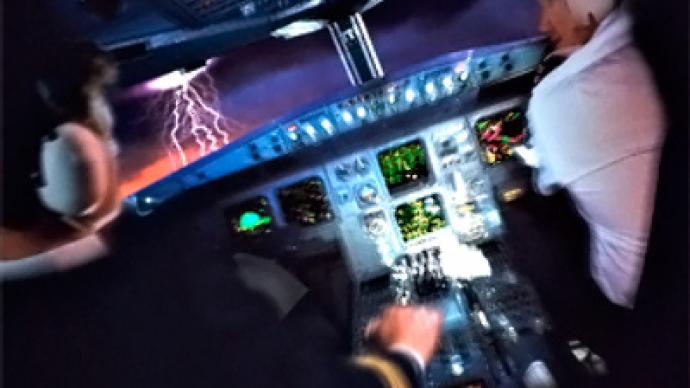
As the investigation continues as to what brought down the French airliner over the Atlantic Ocean with 228 people on board, a Russian climatologist believes global warming played a significant part.
For even the most experienced pilots, flying over the Intertropical Convergence Zone (ITCZ) is oftentimes a white-knuckle affair.
The ITC zone is a constantly fluctuating band that is located between 5º north and 5º south of the equator. It produces some of the heaviest precipitation on the planet, as well as the bumpiest airplane rides.
This meteorologically active region, which gives off a constant vertical updraft of air along its path, was known to sailors as ‘the doldrums’ due to the absence of any refreshing breeze. But for passengers on an airplane traveling over the ITCZ, the sensation can be much different.
Indeed, as vertical-flowing air masses move upwards from the surface of the water, sometimes at great speeds, airplanes may feel a lot like a roller coaster ride. Meanwhile, storms in this volatile region can climb to over 50,000 feet, thus forcing pilots, who usually stay at an altitude of 35,000 feet, to search for a way to skirt them.
Tragically, it seems that the pilots of Air France 447 met exactly this sort of perfect storm.
William Voss, head of the Flight Safety Foundation, told Bloomberg that there was an “explosion of weather” along the flight route of the doomed aircraft where three big storm fronts converged.
“If you take a look at the satellite information online it was like an explosion of weather at the time the Air France flight would have been trying to pick its way through the Intertropical Convergence Zone,” he said.
“The area of weather along that route of flight wasn’t even there when the aircraft was leaving the coast,” Voss added.
But for the most part, these transatlantic trips, as every seasoned pilot and passenger will tell you, are usually uneventful. That optimistic point of view was greatly challenged on June 1, however, when a state-of-the-art Airbus A330-203 vanished over a remote stretch of the Atlantic Ocean four hours after it departed Rio de Janiero, Brazil for Paris, France.
After all, airplanes are not supposed to fall out of the sky: 94 percent of all accidents involving aircraft occur during take-off and landing.
Does global warming pose a threat to the airline industry?
Although the exact cause of the tragedy may never be fully known (according to investigators, the sea floor where the plane went down is extremely rugged, thus making the discovery of the all-telling black box a real long shot), most experts seem to agree on one thing: severe weather conditions played an important part. And that unsettling conclusion is leading some climatologists to wonder if the airlines are properly prepared for a world of higher temperatures and wilder weather, and therefore more stressful flight conditions in the future.
“A consequence of global warming is that the frequency and severity of such events (severe weather conditions) is higher,” Aleksey Kokorin, head of Russia’s World Wildlife Fund’s Climate Program, told RT. “Unfortunately, the risk for airplanes, especially in tropical areas above water, will be higher. This could be difficult for pilots to understand.”
Kokorin said that global weather conditions are becoming more severe, and the cause goes back to one source: the acceleration of the greenhouse effect due to the activities of man on earth.
“We are seeing the same with other (meteorological) events… We see more powerful typhoons than before. We see more powerful cyclones from the North Atlantic, which causes very heavy rainfall and floods in Europe. These are different events of the same reason: warmer surface of the ocean due to global warming, which is a result of the greenhouse effect, unfortunately man made,” he said.
The climatologist then explained why increased global temperatures could make flying in some parts of the world especially challenging.
“If the temperature of the water surface is higher, this produces a stronger convective movement of the air and a high probability of very severe thunderstorms.”
Kokorin then advised that airlines consider using “safer routes” to avoid severe weather patterns in the future.
“Air companies should use maybe a bit more safe routes to… minimize the risks that airplanes have with very serious convective movements of air,” Kokorin said, before acknowledging that more intense ‘convective movement of air’ is not just limited to the tropic regions. “Sometimes it may happen not just in the tropics; therefore we must monitor these conditions around the world.”
Should we be afraid to fly?
Industry experts all seem unanimous in the belief that modern aircraft can handle anything that Mother Nature can throw at them. Indeed, airline pilots regularly share experiences about having their aircraft hit by a bolt of lightning, or bounced by bone-breaking turbulence. And at the time of this writing, French media is beginning to wonder if pilot error, as opposed to bad weather per se, was the real culprit.
Airbus will advise its pilots on how to handle severe weather conditions, Le Monde reported today. The information will remind pilots to maintain adequate speed during moments of high turbulence, as well as keep the plane from banking too sharply.
(*Update: On Friday, Brazilian military officials said that debris pulled out of the sea Thursday were not from the missing Air France plane. "No material from the flight was removed," Brazilian Air Force Gen. Ramon Cardossa said, according to a story by the Associated Press. "What we saw was debris that belonged to some aircraft that were left behind because we have a priority on the search (for) bodies." Brazilian authorities maintain, however, that a 23-foot piece of airplane, an airline seat, and other parts, which have not been plucked from the water, do belong to Air France flight 447. The article provided no details as to what plane the found debris was from).
Some observers interpret this to mean that investigators might know the real cause of the accident but aren't saying.
“If they know what happened, they have a duty to make a recommendation, for safety reasons,” Jean Surrat, a retired airline pilot, told Agence France Presse. “The first thing you do when you fly into turbulence is to reduce speed to counter its effects. If you reduce speed too much you stall.”
However, this version of events doesn’t mesh with the present theory, based on the widely scattered wreckage of the aircraft, and in-flight data sent from the plane's on-board computer, that the aircraft must have come apart while in mid-flight.
One Russian commercial pilot, Aleksandr, who requested that his last name not be used, said that the absence of radio communication from the pilots to ground control seems to prove the plane experienced some sort of “catastrophic” damage in flight.
“Because the aircraft’s last automated messages was sent by the onboard computer system to another computer at the airport, without any communication that we know of from the pilots,
suggests to me the plane broke apart in flight,” the veteran pilot said. "I am even tempted to believe that a bolt of lightning punched a hole in the aircraft."
Meanwhile, Russian General Pyotr Deinekin, a former commander of the Russian Air Force, postulated the tempting theory that although the flight crew was equipped with “onboard devices enabling it to see a dangerous situation beforehand” the pilots would have needed “great courage” to turn their planes back to base due to financial considerations.
“Since this (turning a plane around) involves great financial losses for the airline, the captain apparently decided to continue the flight, which ended up tragically,” Deinekin told Interfax.
This theory brings to mind the crash of a Pulkovo Airlines flight in August 2006 after the pilot made an attempt to fly over a storm, instead of turning around.
Russia’s Interstate aviation Committee blamed the crash, which killed 170 aboard the Tupolev TU-154, on pilot error.