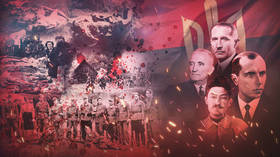
Defending the city that never surrendered
Published 5 May, 2010 04:20 | Updated 5 May, 2010 14:03The Battle for Moscow in 1941-1942 lasted more than seven months and was one of the bloodiest in WW2 history. Ahead of Victory Day, RT recalls what it took to defend the capital.
Moscow has always remained the country's heart. But in 1941 this heart was almost stopped.
“For Hitler, defeating Moscow meant winning the Second World War – something he wanted more than anything else. He planned to destroy it, to raze it to the ground and to make a lake instead,” says historian Boris Nemtsov, himself a veteran and witness of the Battle for Moscow. “His generals didn't skimp on the forces required – almost half of all artillery, aviation, tanks and personnel were pushed into the battle for Moscow.”
Traveling 60 kilometers per day, the German army had covered one-third of the distance to Moscow in just one week. In a fortnight it was already over half way there and in a month the bright lights of the Kremlin were in the Nazis' sights.
The Third Reich was convinced the Soviet capital would be defeated in days. They even carried with them several tons of red granite to erect a monument to Hitler. But fate decided otherwise. Moscow never surrendered.
The Soviet defensive operation, known as Vyazemsky kotel, or Vyazemsky pocket, took place almost 250 kilometers west of Moscow. It was one of the bloodiest conflicts of the battle for the capital, but helped shape its eventual outcome.
“The Soviet Army had been containing the enemy there for more than two weeks, they won enough time for reinforcements to come but also weakened the Germans a lot. That allowed the Red Army to start a counter-offensive just a month later,” explained military historian Andrey Soyustov.
But the victory was not only forged on the frontline. On November 7, 1941, amidst the hardest times for the entire country, Stalin ordered a military parade to be held on Red Square, in the very heart of Moscow.
“It did not have any military point, only political, because it was meant to demonstrate that despite the enemy standing near Moscow we were ready to defend ourselves to the bitter end and not be broken psychologically,” said Boris Ilizarov, historian from the Russian Academy of Sciences. “Stalin was a good psychologist. So in this respect it was a powerful move.”
Moscow was saved, but many believe the price was too high – hundreds of thousands were killed defending it.
And the battlefields are still littered with soldiers’ remains.
Every April, as soon as the snow melts, Andrey Korneev and his team dig for historical artifacts and to pay tribute to all those who sacrificed their lives for the victory.
“People's bones are everywhere here,” he says. “They lie so that it's easy to understand that they were not buried. Those men and women jut died there where death caught them. We try to find out who they are, but even if we don't, we lay them to rest properly, just as they deserve.”
But while some of them will never be identified, their sacrifice to ensure the heart of Russia kept beating and will never be forgotten.