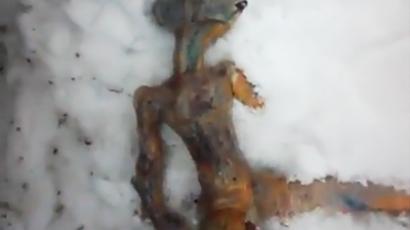
Signs of life: Alien ‘scorpions’ found on Venus?
Published 23 Jan, 2012 16:26 | Updated 23 Jan, 2012 22:14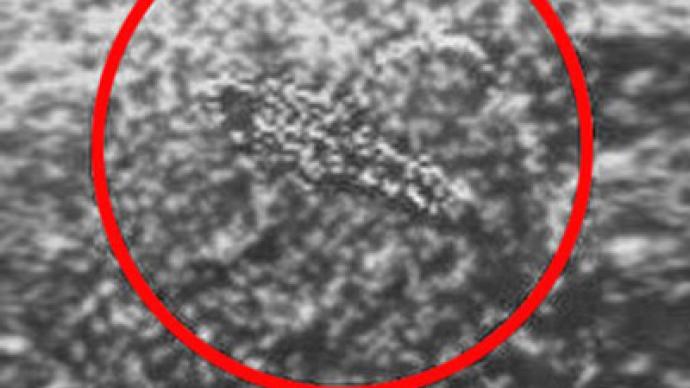
Are we still alone in the universe? Well, if a Russian scientist is right, a Soviet probe already solved one of humanity’s greatest riddles by discovering alien life on a neighboring planet - three decades ago.
While generations of stargazers dreamed of little green men on Mars, a recently published article in the Russian Solar System Research (Astronomicheskii Vestnik) magazine says a Soviet probe may have actually captured images of alien life on Earth’s scorching sister Venus back in 1982.The article, penned by Leonid Ksanfomaliti of the Space Research Institute of the Russian Academy of Sciences, presents a detailed analysis of a 126-minute panoramic video recording made by the Venus-13 landing probe.“Without going into the present conception that life would be impossible on Venus given its conditions, we can take a long shot and say that the given morphological characteristics allow us to assume that certain objects [registered on the planet’s surface] have qualities of living beings,” the researcher claims.The article mentions three distinct objects: “a shape shifting disk,” “a black patch” and something resembling a “scorpion” which all exhibited signs of life.Professor Ksanfomaliti said the objects, which measured between 0.1-0.5 meters, were constantly moving over time, making it difficult to explain them away as mere technical glitches. Most interesting was the appearance of the ‘scorpion,’ whose movements were recorded a full 26 minutes before disappearing.Ksanfomaliti also says the probe’s noisy touchdown on Venus' surface probably scared off other otherworldly critters, which explains why nothing similar was captured in subsequent recordings.The scientist had an inkling the video showed something potentially spectacular back in the 1980s, but opted to remain silent at the time. But based on a new wave of research dedicated to Earth-sized planets outside of our solar system, Ksanfomaliti decided to mull over the old data.He plans on publishing further results of his findings in upcoming articles.However, Aleksandr Bazilevsky the laboratory chief from the Russian Academy of Science’s Geochemistry Institute, says that while Ksanfomaliti is “a true, serious scientist,” his theory is “flawed.” “The life forms we are familiar with are protein-based and they would never survive on Venus,” Bazilevsky says.“We know life forms capable of surviving at pressure of 100 bars on the seabed, and creatures living at the maximum temperature of +150 C in underwater volcanoes. But the temperature on Venus exceeds +500 C.”