VERSIONS: روسيا اليوم NOTICIAS FREEVIDEO ИНОТВ RTД
breakingnews
Go to main page   News   ACTA error: Democracy not found  
MORE ON THE STORY
Protestors shout slogans during a demonstration against the Anti-Counterfeiting Trade Agreement (ACTA) in central Sofia February 11, 2012. (Reuters / Stoyan Nenov) 15.02, 11:21 7 comments

Bulgaria refuses to ratify ACTA

Bulgaria has become the sixth country that has refused to support the international Anti-Counterfeiting Trade Agreement (ACTA).

ACTA
Demonstrators protest against signing of the international copyright agreement ACTA (Anti-Counterfeiting Trade Agreement). (Reuters / Srdjan Zivulovic) 11.02, 22:00 17 comments

Anti-ACTA day: Angry crowds take action (PHOTOS)

The world has witnessed an unprecedented day of protests against ACTA. Hundreds of thousands of people have gathered in dozens of cities around the globe to protect what is left of the freedom of expression on the internet.

ACTA
AFP Photo / Michal Cizek 04.02, 13:07 19 comments

Anonymous calls for anti-ACTA rallies, Poland suspends bill

A wolf in sheep’s clothing – that’s how ACTA opponents have described the international copyright treaty. Thousands are to protest in Sweden on Saturday while in Poland the legislation has been suspended after attacks on government websites.

Demonstrators in masks protest against Poland's government plans to sign ACTA in front of the EU office in Warsaw (REUTERS/Peter Andrews) 27.01, 06:57 2 comments

ACTA: prosecution for communication?

The ACTA copyright protection treaty, which has recently been signed in Poland, represents outdated copyright legislation that could lead to punishment just for an act of communication.

ACTA
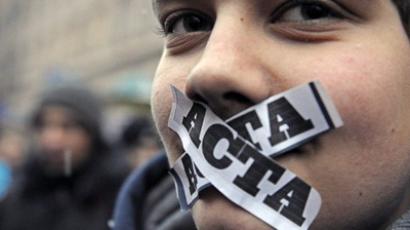
A demonstrator with ACTA stickers on his mouth takes part in a protest against Poland's government plans to sign international copyright agreement ACTA (Anti-Counterfeiting Trade Agreement), in front of the European Union office in Warsaw on January 24, 2012 (AFP Photo / JANEK SKARZYNSKI) 24.01, 21:40 20 comments

An ACTA of war: Secret censor tool to shake up world wide web

As cyberspace turns its attention to the SOPA and PIPA bills in the US, the Anti-Counterfeiting Trade Agreement, or ACTA, has been quietly signed or ratified by most of the developed world and is arguably the biggest threat to Internet freedom yet.

ACTA
16.04.2009, 11:48

“US copyright law is far too strict” – GNU founder

American software freedom activist Richard Stallman, better known as the author of GNU General Public License, joined RT to give his comments on modern software copyright laws, and the risks of cyber sneaking.

ACTA error: Democracy not found
Published: 15 February, 2012, 22:19
Edited: 20 April, 2012, 12:10

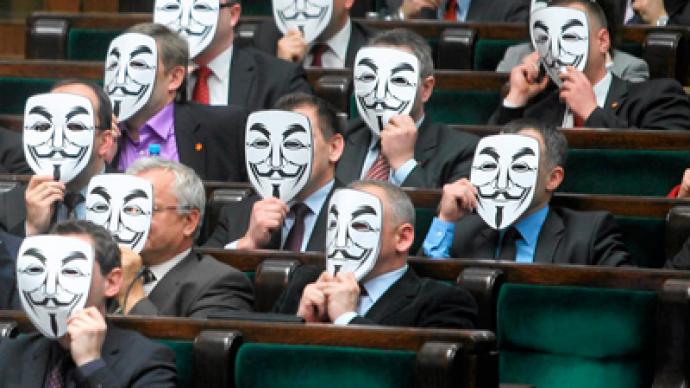
Members of Ruch Palikota Party wear masks during a vote of no confidence for Health Minister Bartosz Arlukowicz in Poland's parliament in Warsaw January 26, 2012 (Reuters / Wojciech Olkusnik / Agencja Gazeta)

Members of Ruch Palikota Party wear masks during a vote of no confidence for Health Minister Bartosz Arlukowicz in Poland's parliament in Warsaw January 26, 2012 (Reuters / Wojciech Olkusnik / Agencja Gazeta)

TRENDS: ACTA

TAGS: Protest, Human rights, Law, Internet, Information Technology


As European parliaments reject the Anti-Counterfeiting trade Agreement on human rights grounds, some are asking why it was signed in the first place.

It looks like some of the countries who signed ACTA in Tokyo on January 26 are already having second thoughts.

I don’t know why I signed ACTA”, former Romanian prime minister Emil Boc said on February 6.

We made insufficient consultations before signing the agreement in late January," said Polish PM Donald Tusk on February 3, implying that his government had not taken steps to fully "ensure it was entirely safe for Polish citizens.”

A few days later Slovenia's foreign minister, who signed the agreement on behalf of her country, apologized for doing so: "Quite simply, I did not clearly connect the agreement I had been instructed to sign with the agreement that, according to my own civic conviction, limits and withholds freedom of engagement on the largest and most significant network in human history, and thus limits particularly the future of our children."

Lithuanian Justice Minister Remigijus Simasius wrote in his blog: “I don’t know where it came from and how it originated, but I don’t like that this treaty was signed skillfully avoiding discussions in the European Union and Lithuania.”

And last Saturday, thousands of people took part in coordinated protest across Europe. Over 200 cities were filled with crowds opposing the controversial agreement.

On Wednesday Bulgaria and The Netherlands withdrew Support in response to protests.

The question is – why was the agreement signed in the first place, if its chances of being ratified are dropping by the day?

The idea to impose a copyright regime was lobbied by the US and Japan.

The pretext was the protection of intellectual property, and to control Internet resources that could be used by terrorists or to incite riots and other criminal activity.

But in this case, governments will be able to force online service providers to disclose subscribers' information if an account was allegedly used for criminal activity or infringement of trademarks or copyrights.

There's an argument to be made that freedom and security are usually in opposition; the most secured people are in prison, where they hardly have any freedom. Usually, security comes at the price of freedom – and that’s exactly the cost of ACTA.

Professors Douwe Korff of London Metropolitan University and Ian Brown of the Oxford Internet Institute issued a report in August 2011 on the compatibility of ACTA with the European Convention on Human Rights and the EU charter of fundamental rights. Their conclusion: “Overall, ACTA tilts the balance of IPR protection manifestly unfairly towards one group of beneficiaries of the right to property, IP right holders, and unfairly against others.

Whether it tilts the balance of power intentionally or unintentionally is a central question. But those who were so quick to sign the agreement must have been misled about its complexity – and the reach of its powers

­Natalia Novikova, RT

+34 (40 votes)
 
Back to top
next MORE NEWS
Iran steps up its nuclear program. 15.02, 20:18 20 comments

Iran steps up its nuclear program

Iranian President Mahmoud Ahmadinejad has announced the country has begun loading domestically produced nuclear fuel rods into a research reactor near Tehran.

Iran tension
Nigel Farage (AFP Photo / Thomas Samson) 16.02, 01:05 4 comments

‘Greece bound to the euro to keep European project alive’

EU leaders are mulling a delay of the Greek bailout until the country votes in an April parliamentary election, Reuters reports. MEP Nigel Farage calls the option blackmail against Greece, which is being sacrificed to save the European integration.

Eurozone crisis
Davidwillfall February 16, 2012, 18:11
+32

It is always the US trying to screw the entire world. Thankfully some have fought back by rejecting another dose of US cancer.

PeterG February 16, 2012, 17:53
+7

Correction...
Slovenia's foreign mninister did not sign Acta. It was signed by Slovenia's ambassador in Japan, Helena Drnovsek Zorko, sister of the late president Drnovsek.

9ke9 February 16, 2012, 17:51
+17

temudjin1155 wrote in #5

“I don’t know why I signed ACTA”
What have you been elected for ?
Kill yourself !


he already tried , i saw it on video! - don ameeeer !


LOL